A pool cleaning quote can look profitable until travel, administration, material use, and extra tasks consume the difference between your price and your costs. A useful pricing process accounts for the complete visit and sets out exactly what the customer receives.
This guide explains how to calculate pool service pricing, distinguish margin from markup, build understandable packages, and compare actual visits with your original estimate.
Once you have defined your offer, the Pool Service Canva Templates & Marketing Kit from Local Growth Studio on Etsy can help you present your packages in branded posts. Customize every design for your real services, prices, and service area.
Disclosure: Vid2SOP and Local Growth Studio are related brands. The linked digital product is created by Local Growth Studio and sold through Etsy.
Free companion workbook: Pool Service Pricing Calculator. It calculates estimated cost, price per visit, monthly billing, and the impact of additional labor time. It also includes a quote checklist. Edit the yellow input cells and replace the illustrative figures with your own records.
1. Define the service before setting the price
"Weekly pool service" needs a written scope. Two providers may use that description for different tasks.
- State visit frequency: weekly, every two weeks, or a defined seasonal schedule.
- List included tasks, such as skimming, brushing, vacuuming, basket cleaning, water testing, chemical adjustments, visual equipment checks, and a visit note.
- Explain the chemical policy: included, billed separately, or included up to a defined allowance.
- Identify separately quoted work, such as initial cleanup, green-pool recovery, repairs, filter deep cleaning, storm cleanup, and opening or closing services.
List only what your team actually provides. In a lighter package, explain which tasks remain the homeowner's responsibility. A defined scope gives you a service you can cost and gives the customer something specific to evaluate.
2. Calculate the cost of a complete visit
Include work at the pool, travel allocated to the stop, preparation, and related administration. Use realistic labor costs, including applicable employment costs. If you do the work yourself, include compensation for your time.
Account for chemicals and consumables, vehicle use, equipment maintenance or replacement, and a reasonable allocation of business overhead. Do not count expenses twice: an hourly labor cost that already includes payroll costs should not receive the same addition again.
A worked example
These invented figures demonstrate the method. They are not market rates or a recommended quote.
| Item | Example cost |
|---|---|
| Labor: 30 minutes on site, 10 travel, 5 administration at $28/hour | $21.00 |
| Chemicals and consumables | $7.00 |
| Vehicle costs allocated to the visit | $4.00 |
| Equipment allowance, already covered elsewhere in this example | $0.00 |
| Allocated overhead | $8.00 |
| Total estimated cost per visit | $40.00 |
The equipment allowance is zero only for this example. Enter your own allowance if equipment costs are not covered elsewhere. Keep service notes in the administration allowance if that is where you record them, rather than including the same time on site too.
3. Set a target margin and understand markup
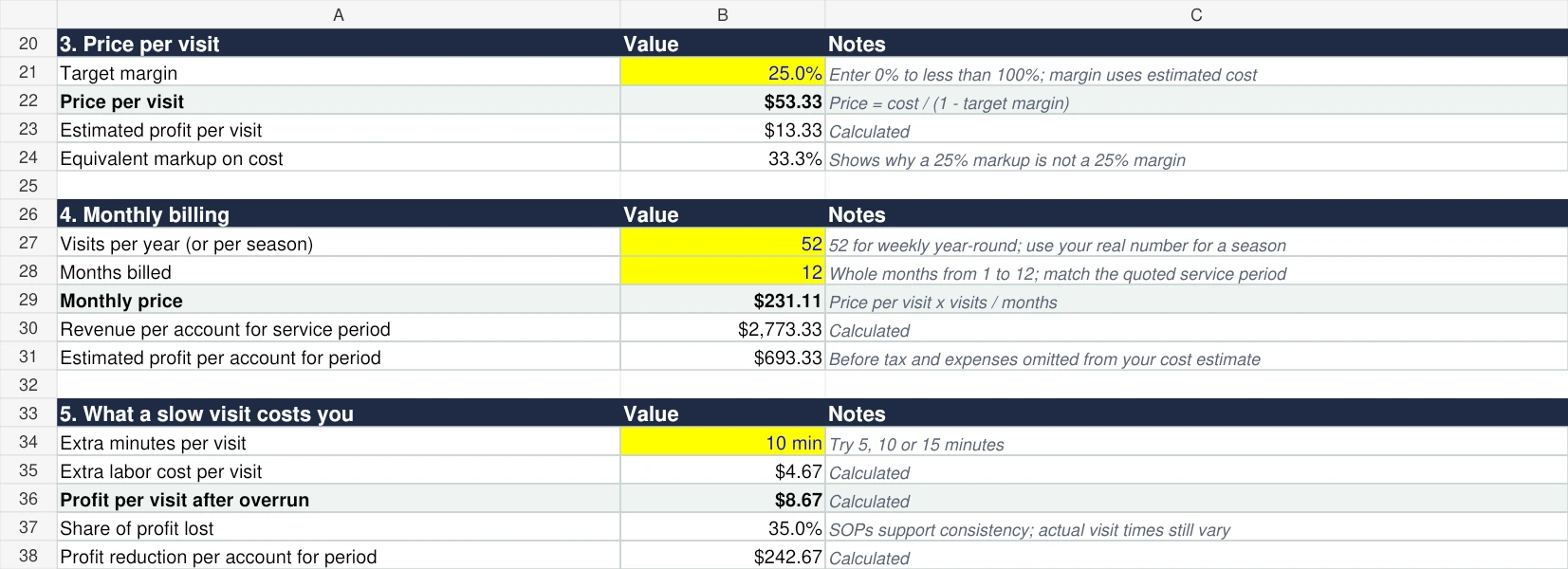
Adding 25% to a $40 cost produces a $50 selling price. The $10 difference is 20% of that price. A 25% markup therefore produces a 20% margin on this cost base.
Use this formula for a target margin:
Price = estimated cost / (1 - target margin)
At a 25% target margin, $40 / 0.75 produces approximately $53.33 per visit.
| Target margin | Divide the $40 cost by | Illustrative price |
|---|---|---|
| 20% | 0.80 | $50.00 |
| 25% | 0.75 | $53.33 |
| 30% | 0.70 | $57.14 |
| 35% | 0.65 | $61.54 |
This is an estimated margin on the costs you included. Taxes and omitted expenses can change the final result. The workbook rejects margins of 100% or more and flags missing or invalid inputs rather than returning a plausible zero price.
4. Compare prices for a comparable local service
Start from your costs, then examine what providers charge locally for the same scope. Compare visit frequency, chemical policy, pool condition, included tasks, and separately priced services.
HomeGuide's pool maintenance cost guide lists a general $80-$150 monthly range for weekly or biweekly cleaning. HomeAdvisor's guide also lists $80-$150 per month for cleaning and water testing. These consumer estimates are broad context, not a price ceiling or proof of what a full-service package costs in your area.
If your estimate is higher, investigate route time, workload, and scope before reducing it. A lower published range is not evidence that your own cost-based quote is wrong. If customers will not pay a sustainable price, reconsider the service design or route fit.
5. Convert the visit price into monthly billing
For an illustrative year-round plan with 52 visits and 12 billing months:
Monthly price = price per visit x planned visits / billing months
The workbook retains the unrounded visit-price calculation and returns $231.11 per month for this example. If you first round the visit price to $53.33, the result is $231.10. Use a consistent rounding policy in your actual quote and invoice.
For seasonal service, enter the visits planned for that season and the number of months billed. The workbook labels totals for the service period so seasonal figures are not mistaken for annual figures.
Explain holidays, access problems, weather interruptions, and rescheduling. A fixed monthly payment should still refer to a defined service schedule.
6. Assess the pool and route before confirming the quote
Assess pool size, current condition, debris load, access, equipment condition, expected material use, and distance from your existing route. A nearby stop and an isolated address can require different amounts of delivery time.
Quote necessary initial cleanup separately. You can explain: "Initial cleanup is quoted separately. Recurring maintenance begins once the pool reaches the agreed starting condition."
Compare accounts using both revenue and the total cost of serving them. A larger monthly payment does not automatically make a distant or time-consuming account more valuable.
7. Build packages with meaningful differences
Use package names that help customers understand the scope.
| Offer | What to clarify |
|---|---|
| Limited maintenance plan | Specific tasks included and the homeowner's remaining responsibilities |
| Routine full-service plan | Cleaning scope, testing, chemical policy, visit schedule, and reporting |
| Separately quoted work | Assessment, agreed scope, and price approval for unusual or occasional needs |
Offer a limited plan only if it suits your operations. Labels such as "Premium" need a real service difference behind them.
The Pool Service Canva Templates & Marketing Kit can help you present your finalized packages consistently. Accurate wording and clear terms remain essential.
8. Write an offer that makes the next step clear
Use a specific service, location, and request:
"Weekly pool maintenance in [your service area]. Receive a written quote outlining your visit schedule, included tasks, chemical policy, and separately priced services. Send your ZIP code and pool details to request an assessment."
Replace the service area with your actual coverage before using this sample. If you advertise a starting price, explain the qualifying conditions alongside it.
For promotion examples, read Pool Service Social Media Posts and How to Market a Pool Cleaning Business.
9. Compare the visit you priced with the work delivered
In the example, the estimated difference between price and cost is $13.33 per visit. Ten additional labor minutes at $28/hour cost approximately $4.67. Holding price and other costs constant, estimated profit falls to $8.67, a 35% reduction. Repeated across 52 visits, that extra labor totals approximately $242.67.
The workbook models additional labor only. Longer visits may also change material use or vehicle costs. If your own extra time does not create an immediate wage expense, it still consumes capacity that could serve other customers.
When visits take longer, investigate conditions, travel, unclear scope, training needs, and callbacks. Do not pressure technicians to skip necessary tasks or safety steps to meet an arbitrary time target.
Document a consistent routine with Vid2SOP
Record a well-run visit that matches the package you priced. Capture the sequence and explain important checks. Obtain permission before recording at a customer's property and avoid exposing identifying details.
Use Vid2SOP to capture visual steps from the video and assemble an editable SOP draft. Add or review the written instructions, scope, and timing expectations. A supervisor should review the procedure and use it alongside hands-on training.
A documented routine can help a team deliver consistent work and investigate overruns. It does not guarantee visit duration. Chemical handling must follow product labels and your safety procedures.
10. Check the quote before sending it
The workbook includes a checklist for property and service area, assessed pool condition, visit frequency, included tasks, chemical policy, initial cleanup, exclusions, payment schedule, access and rescheduling, quote validity, and customer acceptance.
Save the agreed scope with the customer's service record. The technician completing the work needs access to what was promised.
11. Review results after the first month
Compare actual labor and travel time, material use, customer communication, and unplanned work with your estimate. Identify whether the difference comes from pricing, route design, property condition, scope, or the service process.
Review costs periodically and communicate any price adjustment according to the customer's agreement. Before offering a promotion, calculate its delivery cost and define its end date. Clearer quotes and easier scheduling are also worth testing without automatically reducing your price.
Track which marketing posts generate suitable quote requests and which requests become sustainable accounts. Keep improving the messages that attract customers you can serve well.
Frequently asked questions
How much should I charge for pool cleaning?
Calculate your complete cost per visit, choose a target margin, then assess comparable local offers. There is no single price appropriate for every pool, route, and service scope.
Should I charge per visit or per month?
Both approaches can work. Per-visit billing makes individual charges explicit; monthly billing provides a predictable schedule. Define service frequency and exceptions either way.
Should chemicals be included?
Choose a policy that fits your costs and service. Explain whether chemicals are included, billed separately, or covered by an allowance before acceptance.
How do I compete with a cheaper provider?
Compare scope, schedule, communication, and reporting. Avoid matching a price that cannot cover the cost of delivering the promised service.
Can an SOP prevent every overrun?
No. It can support training and consistency, but property conditions and unexpected issues still affect duration. Use actual visit records to refine estimates.
Turn your estimate into an offer you can deliver
Start with a defined scope, calculate complete delivery costs, and review actual results. Use the free companion calculator to work through your own figures, the Etsy marketing kit to present your offer, and Vid2SOP to document the visual steps of your routine.
The figures in this guide are illustrative. Estimated profit excludes taxes and any expenses omitted from the model.
Put your process into practice
Define your service scope, calculate complete delivery costs, and compare actual visits with your estimate before promoting your offer.
Create your SOP