A cleaning business becomes easier to manage when every repeated job follows a clear process. Without a standard operating procedure, each cleaner may complete the same task differently. That creates missed steps, inconsistent quality, longer training time, and more callbacks from clients.
A cleaning SOP gives your team a repeatable way to perform the work. It explains what to prepare, what to clean first, what quality checks to complete, and what proof should be collected before leaving the job.
This guide gives you a practical cleaning SOP structure you can adapt for residential cleaning, office cleaning, turnover cleaning, move-out cleaning, and recurring maintenance jobs.
What Is a Cleaning SOP?
A cleaning SOP is a step-by-step document that explains how a cleaning task should be completed. It is more detailed than a simple checklist because it includes purpose, scope, tools, responsibilities, procedure steps, quality checks, and proof of completion.
A checklist tells the cleaner what to do. An SOP explains how the job should be done.
For example, a bathroom cleaning checklist may say:
- Clean sink
- Clean mirror
- Disinfect toilet
- Mop floor
A bathroom cleaning SOP adds the method:
- Which supplies to prepare
- Which surfaces to clean first
- Which disinfectant contact time to respect
- What order reduces cross-contamination
- What final inspection should look like
- What photo or note should be recorded if something is damaged
Why Cleaning Businesses Need SOPs
Cleaning work looks simple from the outside, but service quality depends on consistency. SOPs help the owner or manager remove guesswork from daily operations.
A cleaning SOP can help you:
- Train new cleaners faster
- Reduce repeated explanations
- Keep quality consistent across workers
- Avoid skipped tasks
- Make client expectations clearer
- Protect the business when a job is disputed
- Turn good workers' habits into repeatable team standards
If your team already records short training videos, those videos can become the foundation of your SOP library. Instead of writing everything manually, you can turn a video demonstration into written steps, screenshots, and a branded PDF.
Cleaning SOP Template Structure
Use this structure for each repeated cleaning process.
1. SOP Title
Write a clear title that describes the task.
Examples:
- Residential Kitchen Cleaning SOP
- Office Restroom Cleaning SOP
- Airbnb Turnover Cleaning SOP
- Move-Out Deep Cleaning SOP
- End-of-Day Cleaner Checklist SOP
Keep the title specific. A vague title like “Cleaning Procedure” is harder to manage when your SOP library grows.
2. Purpose
Explain why the SOP exists.
Example:
This SOP explains how to clean a residential kitchen after a recurring home cleaning visit. It helps cleaners complete the job in a consistent order, reduce missed tasks, and leave the kitchen ready for final inspection.
3. Scope
Define when the SOP should be used.
Example:
Use this SOP for standard residential kitchen cleaning jobs. Do not use it for post-construction cleaning, hoarding cleanup, mold remediation, or jobs requiring special chemicals or equipment.
This section protects your team from using the wrong process for a job that needs a different standard.
4. Required Tools and Supplies
List the tools before the steps begin.
Common examples:
- Gloves
- Microfiber cloths
- All-purpose cleaner
- Degreaser
- Glass cleaner
- Disinfectant
- Mop and bucket
- Vacuum
- Trash bags
- Scrub brush
- Step stool if needed
This prevents workers from starting the job and stopping halfway because something is missing.
5. Safety Notes
Add safety reminders before the procedure.
Examples:
- Wear gloves before handling chemicals.
- Do not mix cleaning chemicals.
- Check product labels before use.
- Ventilate the area when using strong cleaners.
- Report broken glass, sharp objects, water leaks, or electrical hazards.
Safety notes should be short and practical. If the worker will ignore it in the field, rewrite it until it is clear.
6. Step-by-Step Procedure
This is the core of the SOP. Write the steps in the exact order the cleaner should follow.
Example for a kitchen cleaning SOP:
- Inspect the kitchen and note visible damage or unusual conditions.
- Remove trash and replace the liner.
- Clear loose items from counters without moving personal items unnecessarily.
- Use a surface-compatible product on a cool stovetop and included high-grease areas, following its label and the appliance instructions.
- Clean upper surfaces before lower surfaces.
- Wipe cabinet fronts and handles.
- Clean countertops and backsplash.
- Clean sink and faucet.
- Clean appliance exteriors.
- Vacuum or sweep the floor.
- Mop the floor from the farthest point toward the exit.
- Complete final inspection.
Each step should be simple enough for a new cleaner to understand without asking the manager.
7. Quality Check
Add a short quality check section at the end.
Example:
Before leaving the room, confirm:
- Counters are dry and free of visible residue.
- Sink and faucet are clean.
- Trash has been removed.
- Floor is dry and free of debris.
- Supplies have been collected.
- No personal items were misplaced.
Quality checks reduce callbacks because they force one final review before the worker leaves.
8. Proof of Completion
For cleaning businesses, proof matters. Add a section explaining what should be documented.
Examples:
- Before photo if the area was unusually dirty
- After photo for completed high-value areas
- Note if damage was found before cleaning
- Note if a task could not be completed
- Client signature if required
This is especially useful for property managers, Airbnb turnovers, office cleaning, and move-out cleaning.
9. Manager Notes
Leave space for internal notes.
Examples:
- Client prefers fragrance-free products.
- Do not move items on the left office shelf.
- Use client-provided products only.
- Take final photos before locking the property.
These details make the SOP more useful in real jobs.
10. Review Date
Add a review date so old procedures do not stay in use forever.
Example:
Review this SOP every 90 days or whenever the cleaning method, chemicals, client requirements, or quality standards change.
Cleaning SOP Example
Here is a simple version you can adapt:
SOP Name: Residential Kitchen Cleaning SOP
Purpose: Standardize recurring kitchen cleaning for residential clients.
Scope: Standard cleaning visits only.
Tools: Gloves, microfiber cloths, all-purpose cleaner, degreaser, mop, vacuum, trash bag.
Safety: Wear gloves, do not mix chemicals, report hazards.
Procedure: Inspect area, remove trash, apply degreaser, clean surfaces top-to-bottom, clean sink, clean appliances, sweep/vacuum, mop, final inspection.
Quality Check: Counters dry, sink clean, trash removed, floor clean, supplies collected.
Proof: Take photos if required or if unusual conditions exist.
Review: Update every 90 days.
SOP vs Cleaning Checklist
For a working completion record, use the housekeeping checklist. Keep acceptance separate with the cleaning inspection scorecard, and define detail-job scope with the deep cleaning checklist.
A cleaning checklist is faster to use during the job. A cleaning SOP is better for training and standardization.
Use both together:
- SOP: teaches the correct method
- Checklist: confirms the job was completed
For example, a new cleaner can learn the kitchen process from the SOP, then use the checklist in the field to confirm every task was done.
How to Create SOPs Faster From Training Videos
If your best cleaner already knows how to perform a task, record a short process video. The video can show the real order, the tools used, and the quality standard you expect.
Then turn that video into:
- Written steps
- Visual screenshots
- Checklist items
- Notes and safety reminders
- Branded PDF for your team
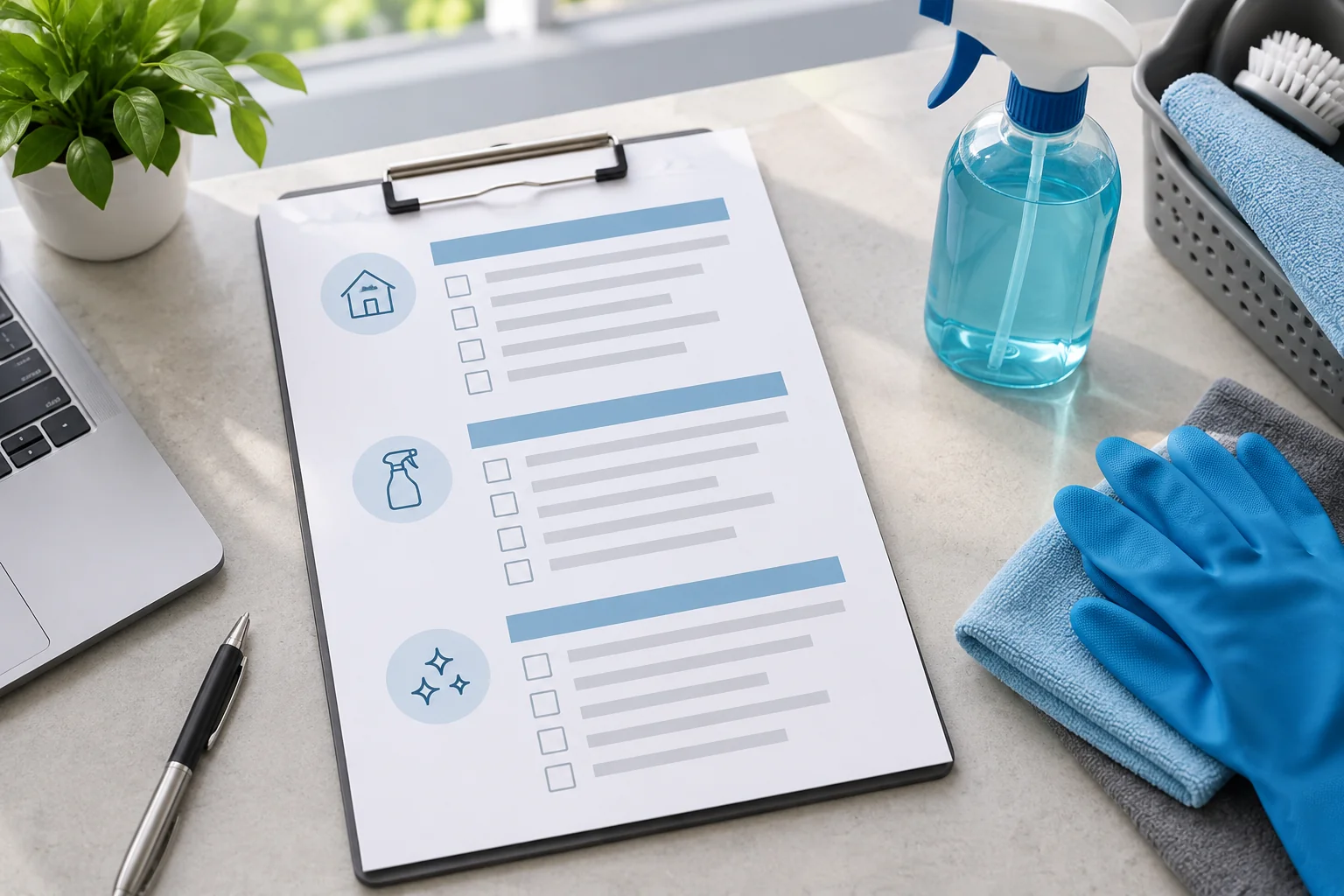
This is where Vid2SOP fits naturally. Instead of starting from a blank page, you can upload a training video and turn it into a professional SOP document.
Final Thoughts
A cleaning SOP does not need to be complicated. It needs to be clear, repeatable, and easy for your team to follow.
Start with one repeated job, such as kitchen cleaning, bathroom cleaning, office cleaning, or Airbnb turnover cleaning. Create one strong SOP, test it with your team, improve it, and then repeat the process for your other services.
The faster you turn your best process into a document, the faster your team can train, standardize, and deliver consistent work.
Put your process into practice
Turn your cleaning training video into a professional SOP PDF with Vid2SOP.
Upload a video, review the generated steps, add your branding, and export a clean SOP your team can actually use.
Create your SOP