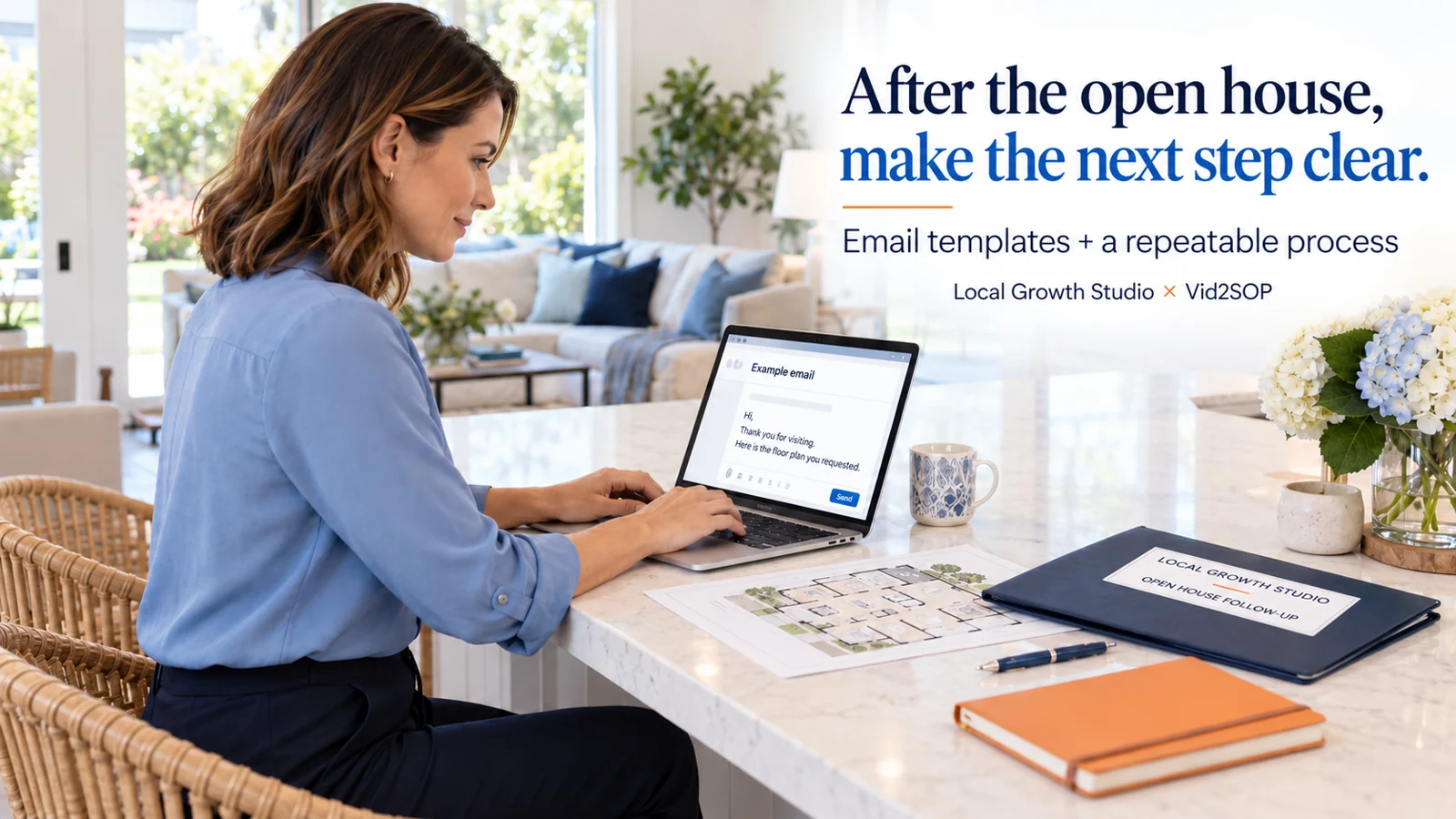
The open house ends with three different promises: send one visitor the floor plan, confirm an answer for another, and check second-viewing availability for a third. Sending everyone the same thank-you leaves those promises unfinished.
A useful open house follow-up email names the home, continues the actual conversation, and makes one next step clear. Start by writing down what you owe each visitor and when you will deliver it. Then choose the message that fits that request.
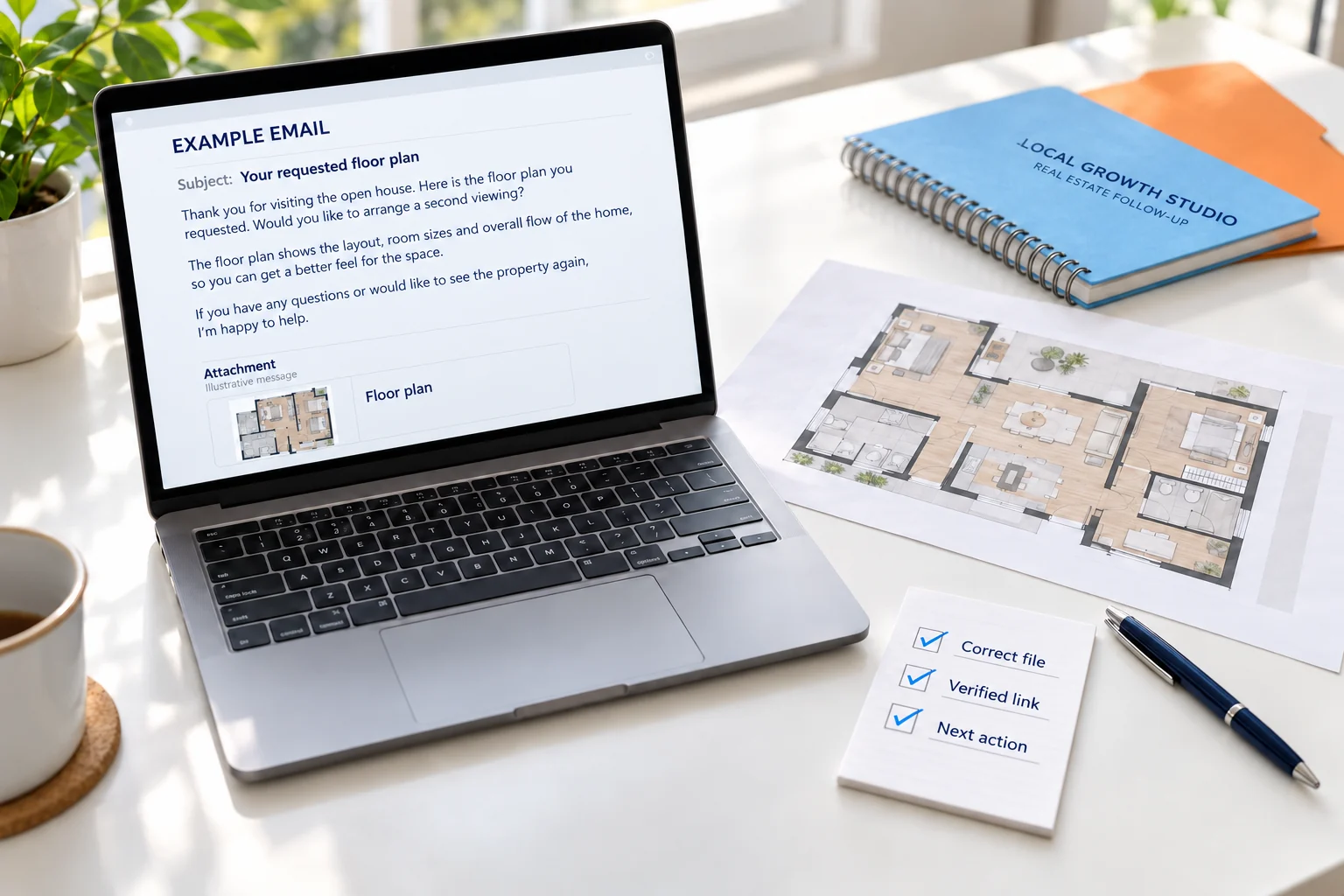
For example, if someone asked for the floor plan, start with: "Here is the floor plan you requested for [Property]: [Verified link]." Check the file, send it by the promised time, and log the next action. That is the core of this guide: finish the specific promise before adding another message.
For a larger collection of editable scripts and a lead tracker, explore the Real Estate Lead Conversion Kit on Etsy from Local Growth Studio, our digital business-resource shop. This optional resource expands the working materials beyond this article; check the listing for current files and formats.
Disclosure: Vid2SOP and Local Growth Studio are related brands. This article links to a digital product from our Etsy shop.
Before choosing a template, check the visit notes
For each person you plan to contact, confirm:
- Which property and event they attended.
- What they asked and what you promised to send.
- Whether email is the channel they requested or agreed to use.
- Whether they told you they already have an agent.
- Who owns the next action and when it is due.
Keep the process relevant to the visitor's request and your brokerage's contact and representation rules. If they have an agent, establish the appropriate communication route before offering further services. Do not treat attendance or an entry on a sign-in sheet as blanket permission for an ongoing marketing campaign.
Check your state regulator's rules on license-holder and brokerage identification in email signatures. For example, Texas TREC lists identification requirements for advertisements including email; follow your own state's rules rather than treating the Texas example as nationwide guidance [3].
This guide concerns U.S. email workflows. Commercial email must meet applicable CAN-SPAM requirements, including accurate sender details and subject lines, advertising identification where required, a valid postal address, and a clear opt-out honored within 10 business days [1]. Check state requirements and brokerage procedures as well; these examples are workflow guidance, not legal advice.
A message is not automatically "transactional" just because a visitor requested a brochure. The FTC defines transactional/relationship categories narrowly; assess the message's primary purpose, and remember that added promotion can change its classification [1].
Keep property descriptions factual, consistent with verified listing details, and free of discriminatory preferences or limitations under applicable fair housing rules [5].
Neighbors and casual visitors who requested nothing should not enter a sales sequence. If they welcomed a follow-up, Template 1 can provide a brief thank-you; otherwise, leave them out of the campaign.
Choose one of seven open house follow-up emails
These are original message bodies. Replace every bracketed field, verify property details, and add your actual signature plus the disclosures and opt-out mechanism your message requires. Send only the relevant version; the seven templates are alternatives, not a seven-email sequence.
1. Thank-you email with a useful question
Use when: the visitor welcomed a follow-up but did not request a specific document or appointment.
SUBJECT: Thank you for visiting [Property]
ALTERNATIVE SUBJECT: Following up on your visit to [Property]
EMAIL: Hi [First name], thank you for taking the time to visit [Property] on [Day]. I appreciated hearing your thoughts about [Actual point from the conversation]. I'm [Agent name] with [Brokerage]. What would be most useful now: more information about this home, or an answer to a question from your visit? Best, [Agent name]
Record next: the question they reply with. If you promised a specific item, deliver it using the next template rather than asking them to request it again.
2. Send the floor plan or listing details they requested
Use when: the visitor asked for a document or a specific piece of listing information that you are authorized to share.
SUBJECT: The [Document] you requested for [Property]
ALTERNATIVE SUBJECT: Your requested [Property] information
EMAIL: Hi [First name], here is the [Document or information] you requested when we met at [Property]: [Verified link or attachment]. It covers [Accurate description of what is included]. Does this answer your question about [Topic], or is there another detail I should confirm? Best, [Agent name], [Brokerage]
Record next: what you sent, when you sent it, and any unanswered question. Open the link yourself, confirm sharing permissions, and check that the attachment belongs to the correct property before sending.
3. Update a visitor while an answer is still pending
Use when: you promised to confirm a detail and need more time or input from the appropriate person.
SUBJECT: Update on your question about [Property]
ALTERNATIVE SUBJECT: Your [Property] question: my next update
EMAIL: Hi [First name], I'm still confirming the answer to your question about [Specific topic]. I have contacted [Appropriate source or role] and will update you by [Realistic date and time], even if the answer is still pending. Thank you for your patience. Best, [Agent name], [Brokerage]
Record next: who needs to provide the answer and when you will update the visitor. Use the sentence about contacting a source only if you have done so. Do not fill the gap with a guess about condition, costs, restrictions, or availability.
4. Arrange a second viewing without implying it is booked
Use when: the visitor expressed interest in returning and you have verified options to propose.
SUBJECT: Viewing options for [Property]
ALTERNATIVE SUBJECT: A second visit to [Property]
EMAIL: Hi [First name], following your request to see [Property] again, I have checked these possible times: [Option 1 with time zone] or [Option 2 with time zone]. Would either suit you? Once you choose, I will confirm the arrangements before you make the trip. Best, [Agent name], [Brokerage]
Record next: the selected option and any coordination still needed. Keep the appointment marked as proposed until the necessary people have confirmed it. If the visitor has an agent, use the communication route established with that agent and your brokerage.
5. Continue through the visitor's existing agent
Use when: a represented visitor has asked you to route property information through their agent and that route is appropriate under your brokerage's process.
SUBJECT: Requested information about [Property]
ALTERNATIVE SUBJECT: [Property]: information requested by your client
EMAIL: Hi [Agent name], [Visitor name] visited the open house at [Property] on [Day] and asked that I send you [Requested information]. Here is [Verified information or link]. Please let me know the appropriate next step for any property questions or a further viewing. Best, [Your name], [Brokerage]
Record next: the receiving agent, the requested information, and the agreed coordination step. Verify the recipient and that sharing the visitor's name and request is appropriate. Do not send this to an assumed agent or use it to solicit a represented buyer.
6. Keep a later check-in tied to an agreed date
Use when: the visitor said their plans are longer term and agreed to a specific future contact.
SUBJECT: Our agreed check-in for [Month or date]
ALTERNATIVE SUBJECT: Following up as agreed on [Date]
EMAIL: Hi [First name], when we spoke at [Property], you said you were considering [Stated plan] around [Timeframe]. We agreed I would check in on [Date]. Is that still useful, or would you prefer another date? Best, [Agent name], [Brokerage]
Record next: the agreed date or a request to pause. Send this on the date you actually agreed, rather than adding the person to a frequent sequence because they may move eventually.
7. Close the loop when there is no reply
Use when: the original contact and channel remain appropriate, the visitor has not replied, and one final message would reasonably close an outstanding request.
SUBJECT: Closing the loop on [Property or question]
ALTERNATIVE SUBJECT: Pausing follow-up on your [Topic] request
EMAIL: Hi [First name], I'm closing the loop on your request about [Topic]. I sent [Requested information] on [Date]. I'll pause follow-up for now, but you can reply if you would like to return to the question later. Best, [Agent name], [Brokerage]
Record next: pause unscheduled outreach. If the requested item has not been sent, use the pending-answer message instead. If the person has already asked you to stop, honor that request rather than sending this additional sales follow-up.
When should you send an email after an open house?
Send requested items by the time you promised. If no time was agreed and a follow-up was welcomed, the same day or next business day is a practical working default. For an explicitly agreed later check-in, use that date instead. These are operating suggestions, not a proven conversion optimum.
For a team that needs an operating starting point, use this example:
- After the event: review notes, confirm the contact route, assign outstanding requests, and send ready information during appropriate working hours.
- Next business day: check that each promised item was sent or that a pending-answer update has an owner and deadline.
- Later in the week: review unanswered requests individually. Decide whether another useful message is appropriate; do not add a contact just to complete a sequence.
- On any agreed future date: complete that check-in, or update the record if the person changed their preference.
This is an editorial task-review framework, not evidence of an optimal sending interval. A reply, a confirmed viewing, a request to pause, or an opt-out changes the plan immediately. For the broader lead stages and first-week example, see the real estate lead follow-up checklist.
An open house follow-up checklist before you press send
Read the finished message as the recipient would. Can they tell which home it concerns and why they received it?
- The subject describes the actual purpose; it does not imply an existing reply thread or invent urgency.
- The name, property, date, and promised item match the visit notes.
- Every bracketed placeholder has been replaced or removed.
- Property details and proposed times have been checked.
- Links and attachments open correctly and share only the intended information.
- There is one clear question or next action.
- The sender identity, required disclosures, postal address, and opt-out are present as applicable.
- The message respects contact restrictions, representation arrangements, and any request to stop.
A floor plan request does not need an unrelated sales pitch. A pending answer needs an honest update. Keeping that distinction visible makes the message easier to review.
Track promises, replies, and viewings separately
Use one record per unique contact and a separate property or event reference when needed. Record the requested item, responsible agent, due time, sent time, meaningful reply, and confirmed viewing outcome. Keep sensitive personal information out of a general shared tracker.
Fictional example: visitor O-103 requested a floor plan at the Sunday event. Agent A promised it for Monday at noon, sent the correct file at 10 a.m., and recorded the action as delivered. The visitor then asked for a second viewing. That is a new request; it becomes a booked viewing only after confirmation.
After an event, review these counts:
- Requests promised and requests completed by the deadline.
- Outstanding questions with an assigned owner.
- Meaningful replies received.
- Viewings proposed, confirmed, canceled, and attended.
If eight visitors requested information and six received it by the promised deadline, the on-time delivery rate is 6 / 8 = 75%. That is a fictional calculation, not a conversion benchmark. Evaluate each event after a comparable follow-up period and preserve the original request count when updates arrive later.
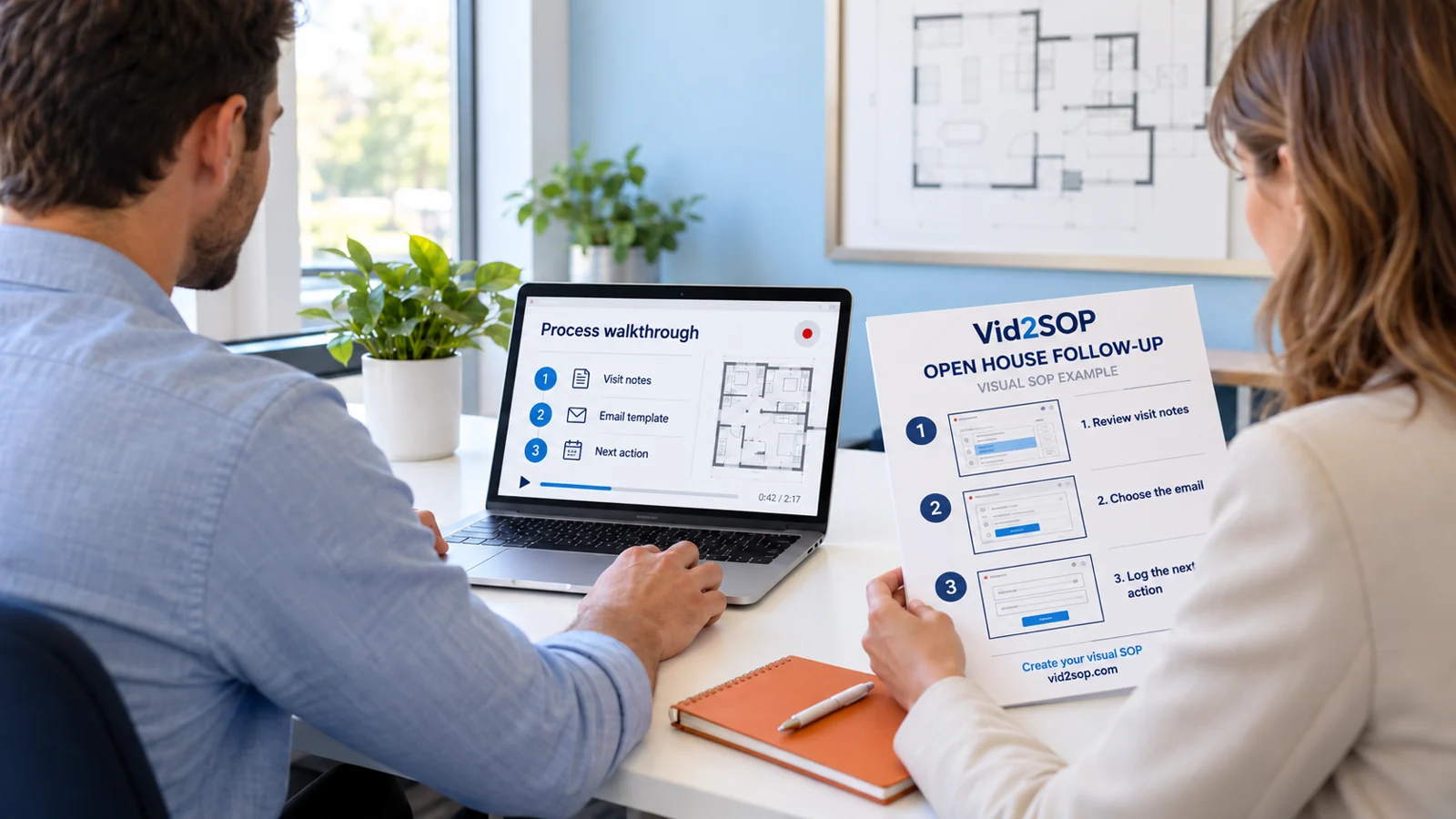
Turn one visitor request into a visual team SOP
Suppose a new teammate is covering Monday's follow-up. They need to find the Sunday visit notes, choose the right email, and record whether a requested floor plan was actually delivered. A visual guide can show the exact screens and the completion check instead of leaving those steps to memory.
Record a short screen walkthrough using fictional visitor O-103. Demonstrate these actions in your existing tools:
- Open the event record and find the visitor's requested item and promised time.
- Confirm the appropriate contact route, restrictions, and assigned agent.
- Select the document-delivery template and replace every placeholder.
- Open the authorized floor-plan link and check its sharing permissions.
- Record the sent time, any new question, and the next action in the tracker.
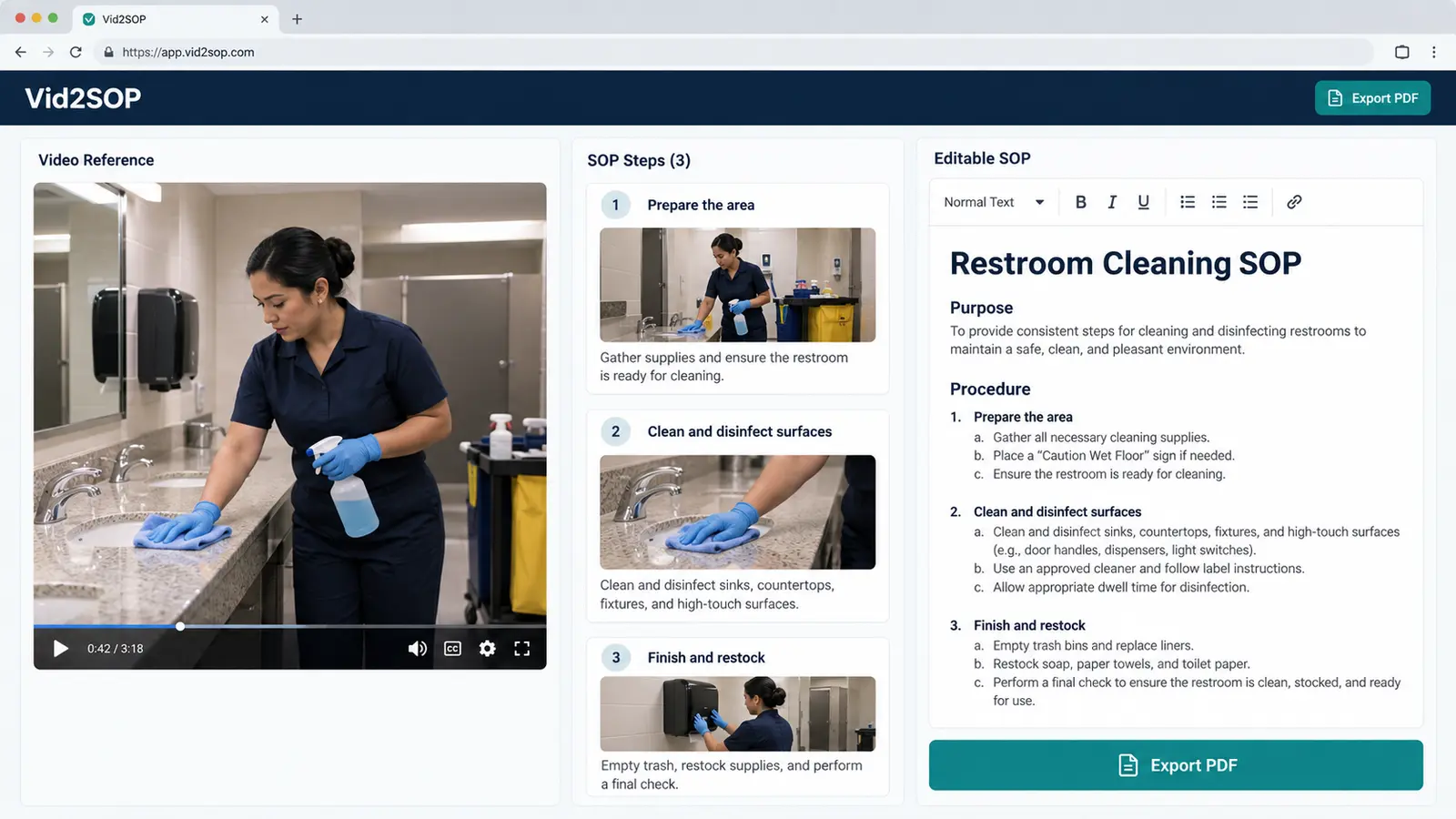
In Vid2SOP, use that recording to capture useful frames. Write an instruction for each selected frame, review the visual draft, and export the SOP as a PDF. The finished guide documents the process; the teammate still sends the email and updates the tracker in those separate tools.
Use this completion check in the guide: "Correct document sent to the intended recipient; delivery time logged; unresolved question assigned." Then ask the teammate to follow the exported instructions with the fictional record and correct anything unclear.
Your next step: record that one walkthrough and create its visual SOP in Vid2SOP. For a document outline covering purpose, responsibilities, steps, and review, use the SOP structure guide.
Frequently asked questions
What should an open house thank-you email include?
Identify the property and visit, acknowledge the actual conversation, and give the recipient one useful next step. If you promised a document or an answer, prioritize delivering it over a generic thank-you.
Should every visitor receive all seven templates?
No. Choose the message that matches the request and the contact you are permitted to make. A document request, a pending answer, and an agreed future check-in are different situations.
Can I text instead of emailing?
Use the person's requested channel. Realtor.com's guide distinguishes short coordination from the fuller details and recaps email can carry [2]. U.S. text-message rules, including the TCPA, can require consent depending on the message and technology; automated marketing texts need particular care [4]. Email permission is not automatically permission to text. Check applicable law and brokerage procedures before switching channels; this page is not legal advice.
What if the visitor already has an agent?
Record that information and follow your brokerage's representation and communication procedures. Where appropriate and requested, route property information through the existing agent rather than beginning a competing solicitation.
Finish the promise before adding another message
Choose the correct template, check the facts, and record one owned next action. At the next review, start with what is still owed. That gives your team a concrete process to improve after each open house.
Sources and editorial method
The scripts, review framework, and fictional example were written for this guide. They do not reproduce a third-party campaign or promise a conversion result. Sources checked October 19, 2026. The Realtor.com page is available in indexed primary-source results; direct access may show a regional restriction.
[1] FTC: CAN-SPAM Act - A Compliance Guide for Business. Commercial email requirements, message classification, and opt-outs.
https://www.ftc.gov/business-guidance/resources/can-spam-act-compliance-guide-business
[2] Realtor.com PRO: Text or email? What is the best approach for real estate lead follow-up? April 3, 2026. Communication preferences and channel use.
[3] Texas Real Estate Commission: Required information in advertisements such as signs, email and business cards. State-specific example, not a nationwide rule.
https://www.trec.texas.gov/node/323
[4] FCC: FCC 24-24, Report and Order. Background on TCPA consent and revocation for robocalls and robotexts; check current requirements for your use case.
https://docs.fcc.gov/public/attachments/FCC-24-24A1.pdf
[5] HUD: Fair Housing - Rights and Obligations. Federal fair housing protections for housing-related activities.
https://www.glb.hud.gov/stat/fheo/rights-obligations
Put your process into practice
Capture frames from your process video, add and review the instructions, and export a visual SOP PDF for your team.
Create your SOP