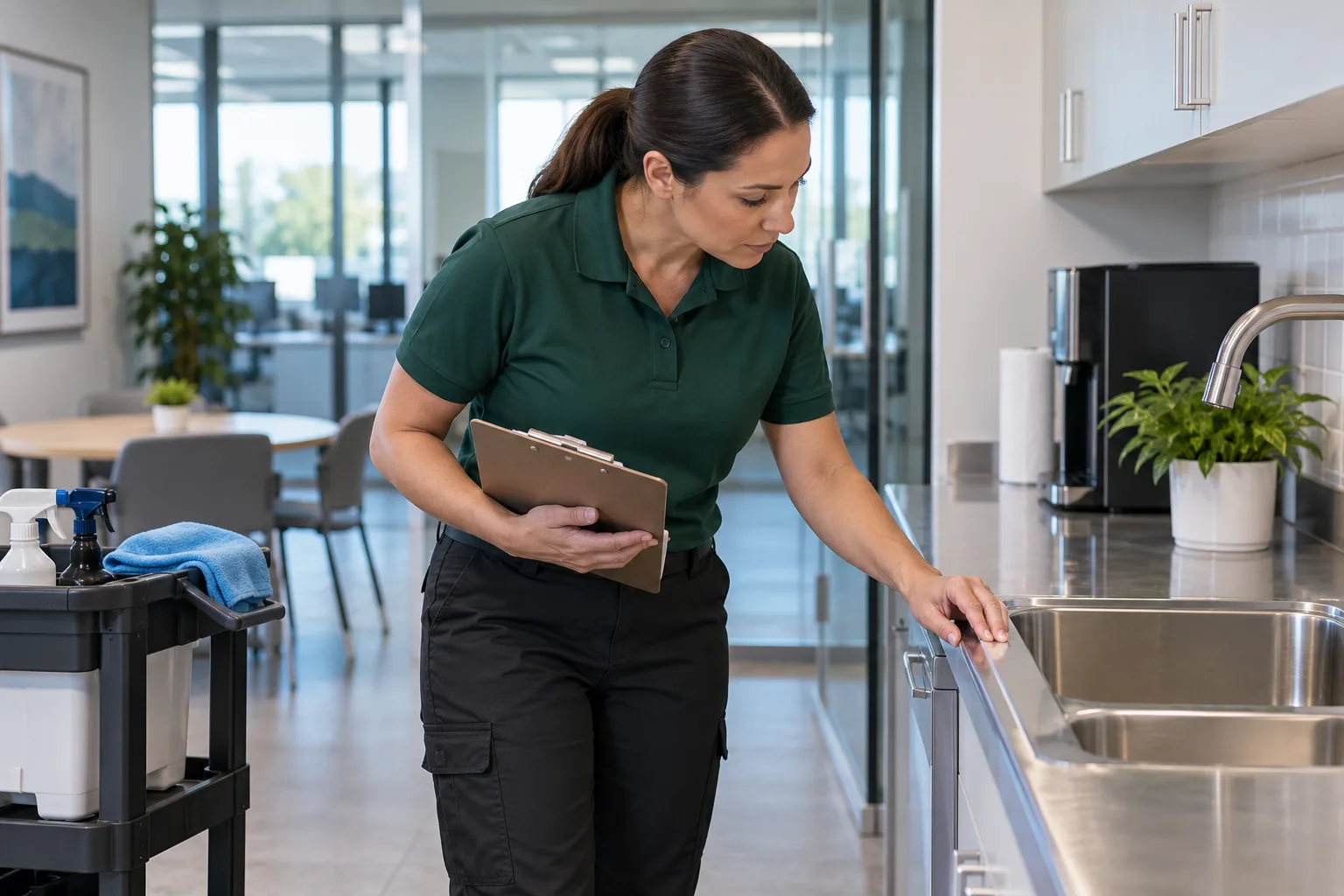
A checked box should mean the employee demonstrated the task correctly — not simply that someone talked about it.
That distinction turns a cleaning staff training checklist from onboarding paperwork into a useful quality-control record. Use the checklist below to plan training, observe real work, document coaching, and decide what the employee can perform independently.
This guide also includes a free printable cleaning staff training record that supervisors can use on site.
Cleaning staff training checklist
Use three clear statuses throughout the record:
- Demonstrated: the employee completed the task to the required standard.
- Needs practice: coaching or another observed attempt is required.
- Not assigned: the task is outside this employee's current role or site.
1. Company and site orientation
- Explain the employee's role, schedule, reporting line, and attendance procedure.
- Review the site's scope of work, restricted areas, access rules, keys, alarms, and closing procedure.
- Show where supplies, equipment, safety information, and personal protective equipment are stored.
- Explain uniform, identification, phone, privacy, and customer-contact rules.
- Confirm how completed work, delays, damage, missing items, and complaints are reported.
2. Safety and chemical handling
- Show where labels and Safety Data Sheets are available.
- Explain the hazards and required precautions for every product the employee will use.
- Demonstrate the approved dilution, dispensing, ventilation, and storage procedures.
- Confirm that products must never be mixed unless the manufacturer explicitly directs it.
- Demonstrate required PPE, hand hygiene, spill response, and incident reporting.
- Review wet-floor controls, safe lifting, sharps awareness, electrical risks, and emergency exits.
The U.S. Occupational Safety and Health Administration's Hazard Communication guidance requires employers to inform and train workers about hazardous chemicals in their work area. Training should happen at initial assignment and when a new chemical hazard is introduced. The NIOSH guide on protecting workers who use cleaning chemicals is another useful reference. Always follow the product label, Safety Data Sheet, equipment manual, and local requirements.
3. Equipment and tool use
- Identify approved color coding or task separation for cloths, mops, and tools.
- Demonstrate equipment inspection before use.
- Demonstrate safe setup, operation, shutdown, cleaning, and storage.
- Explain which faults require the equipment to be taken out of service.
- Confirm the employee knows how to report damaged tools or missing supplies.
4. Core cleaning methods
- Demonstrate the correct order of work for the site.
- Show how to work from cleaner areas to dirtier areas and from high surfaces to low surfaces where appropriate.
- Demonstrate dusting, wiping, restroom cleaning, floor care, waste handling, and restocking tasks in the employee's scope.
- Identify high-touch points and the site's required treatment for them.
- Explain product contact time where the label requires it.
- Show how to prevent cross-contamination between rooms or task zones.
- Demonstrate the final visual check before leaving an area.
5. Quality standard and inspection
- Show an example of acceptable finished work.
- Explain the site's inspection checklist and scoring method.
- Identify frequent defects such as missed edges, streaks, residue, odors, incomplete restocking, or unsecured areas.
- Have the employee inspect their own work before supervisor review.
- Record corrections and repeat the affected task when necessary.
Use our cleaning inspection checklist to make the quality standard visible and consistent.
6. Practical verification
- Ask the employee to explain the task in their own words.
- Observe the employee completing the full task without step-by-step prompting.
- Verify safe product, tool, and equipment use.
- Compare the result with the site's written standard.
- Record the status, coaching note, trainer initials, and follow-up date.
- Authorize independent work only for tasks the employee has demonstrated.
Use the explain-demonstrate-practice-observe-confirm loop
A simple five-part loop keeps training practical:
- Explain the purpose, risks, sequence, and expected result.
- Demonstrate the task at normal working pace while pointing out the critical steps.
- Practice by letting the employee complete the task.
- Observe the process and finished result without taking over too quickly.
- Confirm competence, or document the specific practice still required.
Avoid signing off an entire category because one task looked correct. Someone may be ready to clean mirrors independently but still need coaching on restroom disinfection or floor equipment. Verification should be task-specific.
Record the demonstration once and reuse it
The best demonstrations often happen beside the equipment, inside the actual room, and with the approved products already in hand. Record that demonstration once so the next employee can review the same sequence before practice.
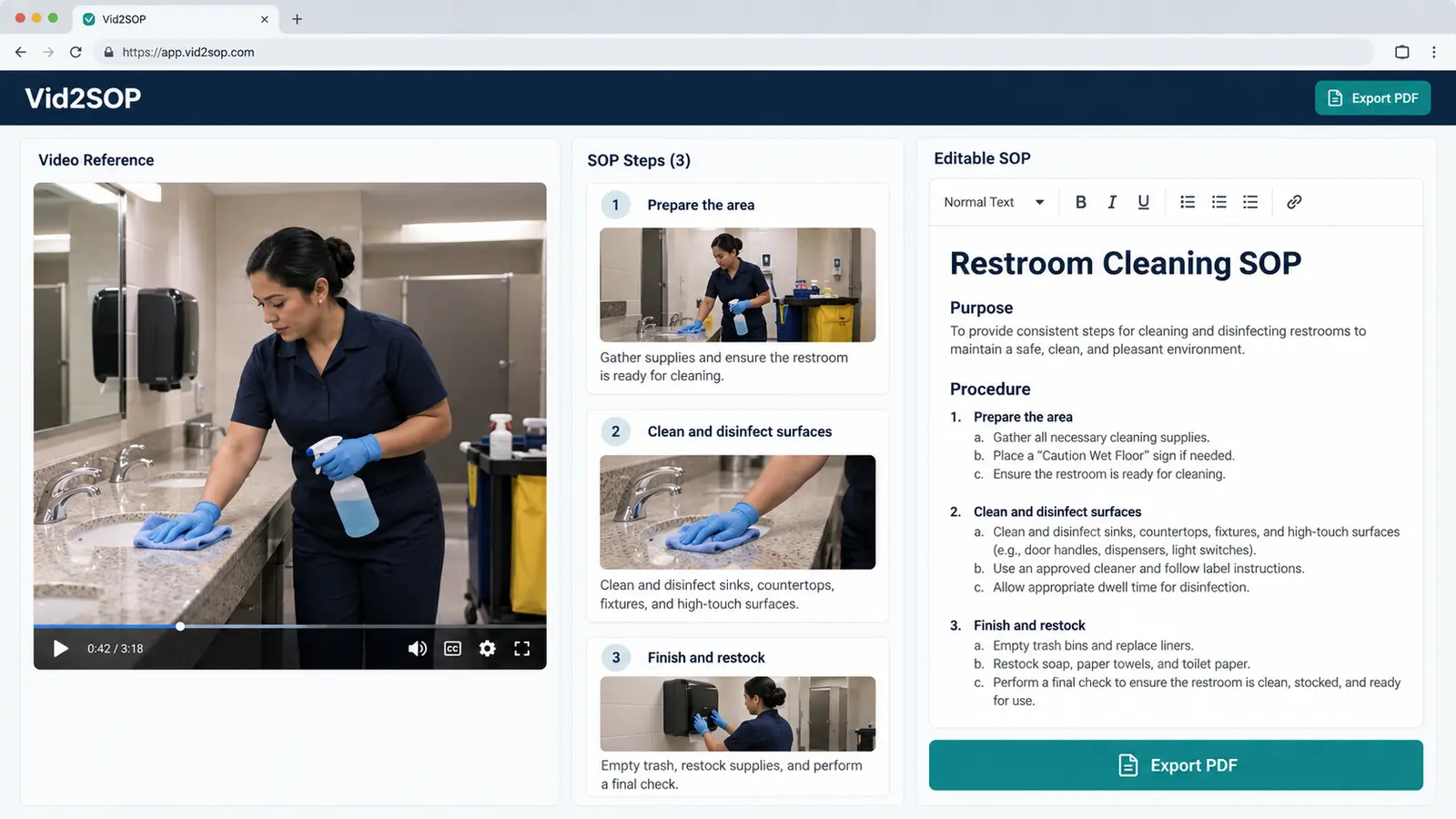
With Vid2SOP, a supervisor can upload the training video and turn it into a draft SOP with visual steps. The supervisor then reviews the wording, corrects the sequence, adds site-specific requirements, and exports the finished procedure for the team.
The result is a reusable reference — not a substitute for supervision. The trainer still observes the employee and signs off the skill in the training record.
For a complete procedure structure, use our cleaning SOP template alongside the training record.
Example completed training record
The example below shows how a short, specific note creates a more useful record than a simple pass or fail.
| Employee | Task | Site | First observation | Coaching and repeat attempt | Final status | Follow-up |
|---|---|---|---|---|---|---|
| Jordan M. | Restroom cleaning | Site A | Followed the sequence but missed the lower door handle during the high-touch check. | Trainer reviewed the high-touch list. Jordan repeated the final inspection and corrected the missed surface. | Demonstrated (after coaching) | Recheck during next scheduled shift |
This entry records what happened, what coaching was provided, and what should be checked next. It also gives another supervisor enough context to continue the training.
Example first-week follow-up plan
This is an example, not a universal timetable. Adjust it to the site, employee, equipment, and risk level.
| When | Supervisor focus | Evidence to record |
|---|---|---|
| First shift | Orientation, chemical information, PPE, access rules, task demonstration | Topics reviewed and employee questions |
| Second shift | Employee practice on assigned tasks | Demonstrated / Needs practice by task |
| Third shift | Work with less prompting and complete a self-inspection | Defects found, corrections, and coaching |
| End of first week | Observe the full assigned route or zone | Tasks approved for independent work and tasks requiring follow-up |
| Later follow-up | Recheck quality, safety, and recurring defects | Refresher training or final confirmation |
Do not rush sign-off to match the schedule. A new cleaner is ready when the required tasks are completed safely and consistently, not merely when a certain number of shifts has passed.
Download the free printable training record
Download the free Cleaning Staff Training Checklist and Training Record (PDF).
The printable includes space for:
- employee, trainer, site, and training dates;
- orientation, safety, equipment, task, and quality checkpoints;
- Demonstrated, Needs practice, and Not assigned statuses;
- coaching notes, follow-up dates, and signatures;
- final authorization for independent tasks.
Keep the completed record with the employee's training documentation according to your company policy and applicable requirements.
Frequently asked questions
What should be included in cleaning staff training?
Training should cover site orientation, chemical safety, equipment, task demonstrations, quality standards, customer and security rules, incident reporting, and practical skill verification. Limit sign-off to tasks the employee actually demonstrates.
How long does it take to train a new cleaner?
There is no single duration that fits every cleaner or site. The schedule depends on the work scope, equipment, chemical hazards, site rules, and the employee's experience. Use observed demonstrations and follow-up checks instead of relying on a fixed number of days.
Can a training video replace hands-on cleaning training?
No. Video and written SOPs make the standard easier to repeat, but a supervisor should still demonstrate the task, observe the employee, correct mistakes, and confirm competence. Video is the reference; observed performance is the evidence.
How often should cleaning training be refreshed?
Refresh training when a procedure, product, piece of equipment, hazard, or client requirement changes. Refresher training is also appropriate when inspections reveal a repeated gap or after an incident shows that the existing method was not understood or followed.
Editorial note
This checklist is a practical operations resource, not legal or safety advice. Adapt it to the actual worksite, manufacturer instructions, Safety Data Sheets, client requirements, and applicable laws. A qualified person should review hazardous tasks and site-specific training before employees perform them independently.
Put your process into practice
Record your best cleaning method once, turn it into an editable SOP, and give every new cleaner the same visual standard. Vid2SOP helps you turn the video into editable visual steps and a professional SOP draft that you can review, brand, and share with every new hire.
Create your SOP