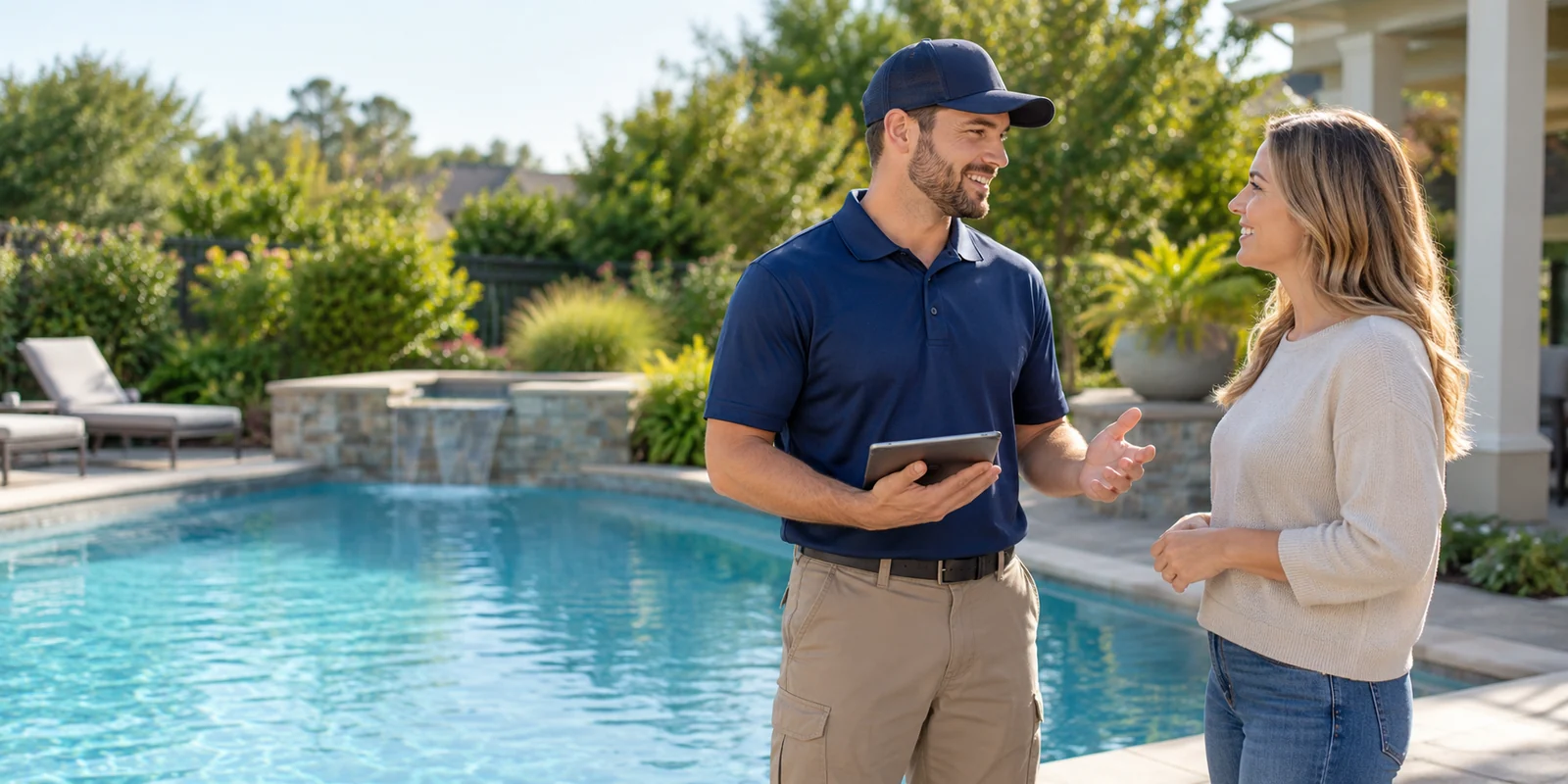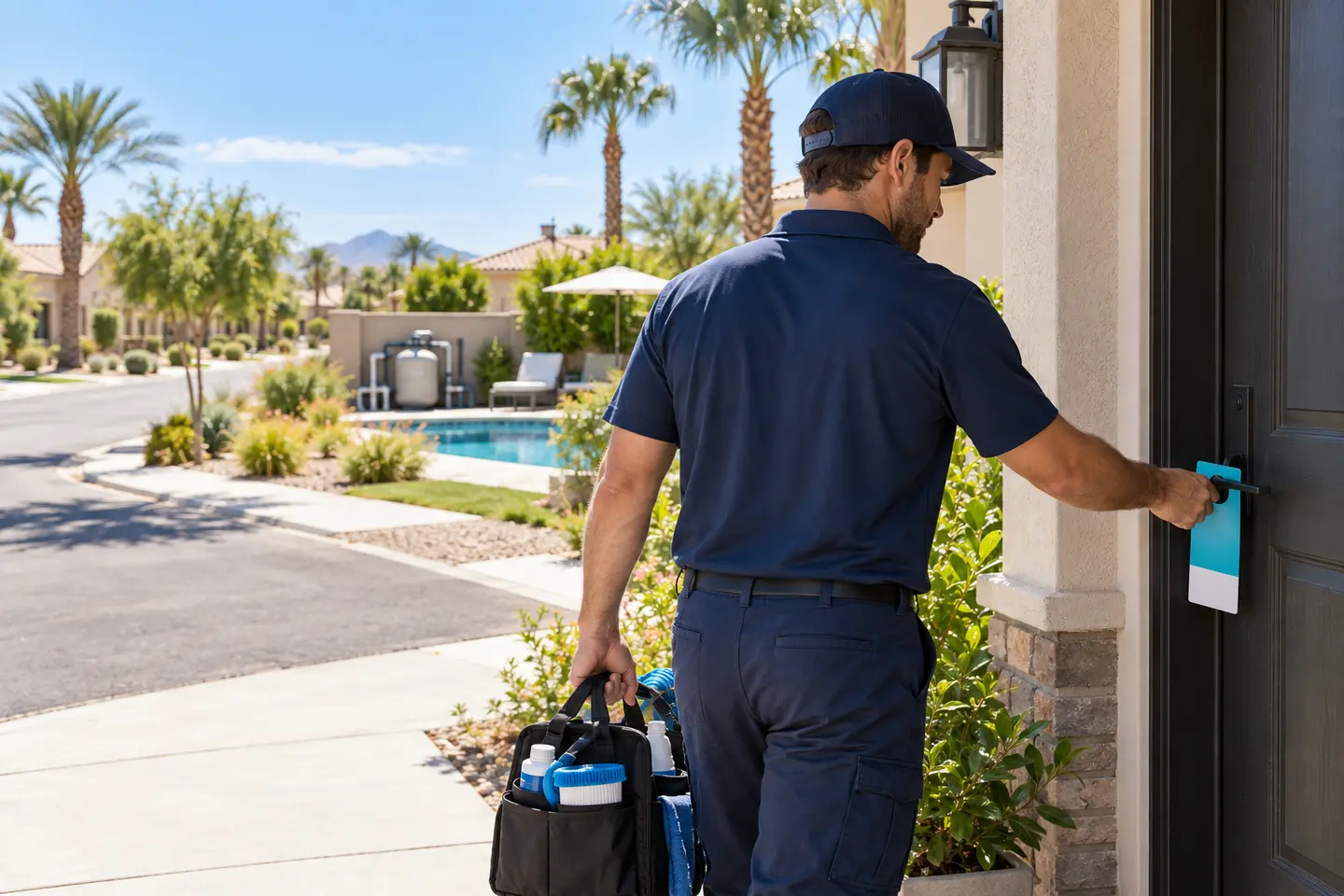
A pool service door hanger is most useful when it reaches a homeowner close to a route your crew already runs. Your message can then be specific: nearby service may be available on a known day, and adding a close-by customer may fit the route better than crossing town for one isolated stop. Say “We service pools in this neighborhood on Tuesdays” only if that is true and you can keep honoring it.
If you are building the design now, the Pool Service Canva Templates & Marketing Kit on Etsy includes editable marketing materials such as door hangers, flyers, social posts, and captions. Customize the copy with your real services, availability, service area, and contact details before printing.
Disclosure: Vid2SOP and Local Growth Studio are related brands. The linked digital product is created by Local Growth Studio and sold through Etsy.
This guide covers route selection, hanger copy, printing, distribution rules, and a simple way to calculate what each inquiry and new customer costs. A downloadable campaign tracker is included so you can log each test instead of relying on memory.
Start with a route, not a large print run
Begin with neighborhoods where your service is a good fit and your team can realistically respond. A concentrated route is easier to explain and measure than a broad drop across an entire city.
- Map current stops by neighborhood. Use broad areas or street segments in your working plan; do not publish customer names, addresses, or route details that expose a home’s schedule.
- Choose a small test area. Look for nearby homes with pools and reasonable access for your crew. A dense route can reduce travel time, but only if the homes are within your service criteria and capacity.
- Confirm availability first. Check the route day, technician capacity, start date, and any service limits before you promise “weekly service nearby” or “limited openings.”
- Pick one offer or next step. Ask the homeowner to request a quote, check route availability, or book a clearly defined introductory service. Avoid stacking several competing calls to action.
- Record the test. Log the route, drop date, hanger quantity, offer, inquiries, booked work, printing cost, and staff time in the campaign tracker.
Do not target a neighborhood just because the homes look expensive. Choose it because its pool owners, geography, service expectations, and access fit the business you can actually deliver.
What to put on a pool service door hanger
Design the piece so a homeowner can understand it in a quick glance. Keep the front focused on one promise and the reverse side useful, rather than trying to describe every service you offer.
- Business name and service: Use the name customers will see on your site and estimate. State whether you offer recurring pool cleaning, maintenance, or another specific service.
- A truthful local detail: Mention a neighborhood or route day only when your schedule supports the claim. If you do not already serve that area, say you are checking demand or asking about route availability instead.
- One clear benefit: Explain what the customer will learn or do, such as request a quote or see what a service plan includes. Avoid guarantees about water clarity, health, safety, or a specific result.
- One response path: Include a readable phone number or short URL. A QR code can be a second option, but do not make scanning the only way to respond.
- A low-friction next step: “Ask whether we serve your street” or “Request a pool-service quote” is clearer than “Call today!” with no context.
- A visual that belongs to your business: Use a permission-cleared pool or team photo, or a design asset you are licensed to use. Never present stock or AI-generated imagery as a customer result.
- Legible contact information: Give the phone number, URL, offer terms, and any required disclosures enough space and contrast to read at arm’s length.
Six headline examples to adapt
Choose one line that matches your current route and real service:
- “Pool service already nearby in [Neighborhood]?” — Use this only if you already serve the area.
- “We’re on this route [Day]” — Print only if the schedule is accurate and stable.
- “Need a pool-service quote in [City]?” — A direct request for a quote, without promising a discount.
- “See what our weekly service includes” — Link to a clear service description.
- “Ask if your address fits our route” — Useful when you are expanding cautiously.
- “A local pool-service option for [Neighborhood]” — A general introduction without implying an existing customer relationship.
Below the headline, add one short sentence about the service and one next step. If you offer an introductory deal, show the actual terms, eligibility, expiration date, and exclusions. Do not use “free,” “limited,” or a savings percentage unless you can honor it and explain the conditions.
Choose print specifications you can reproduce
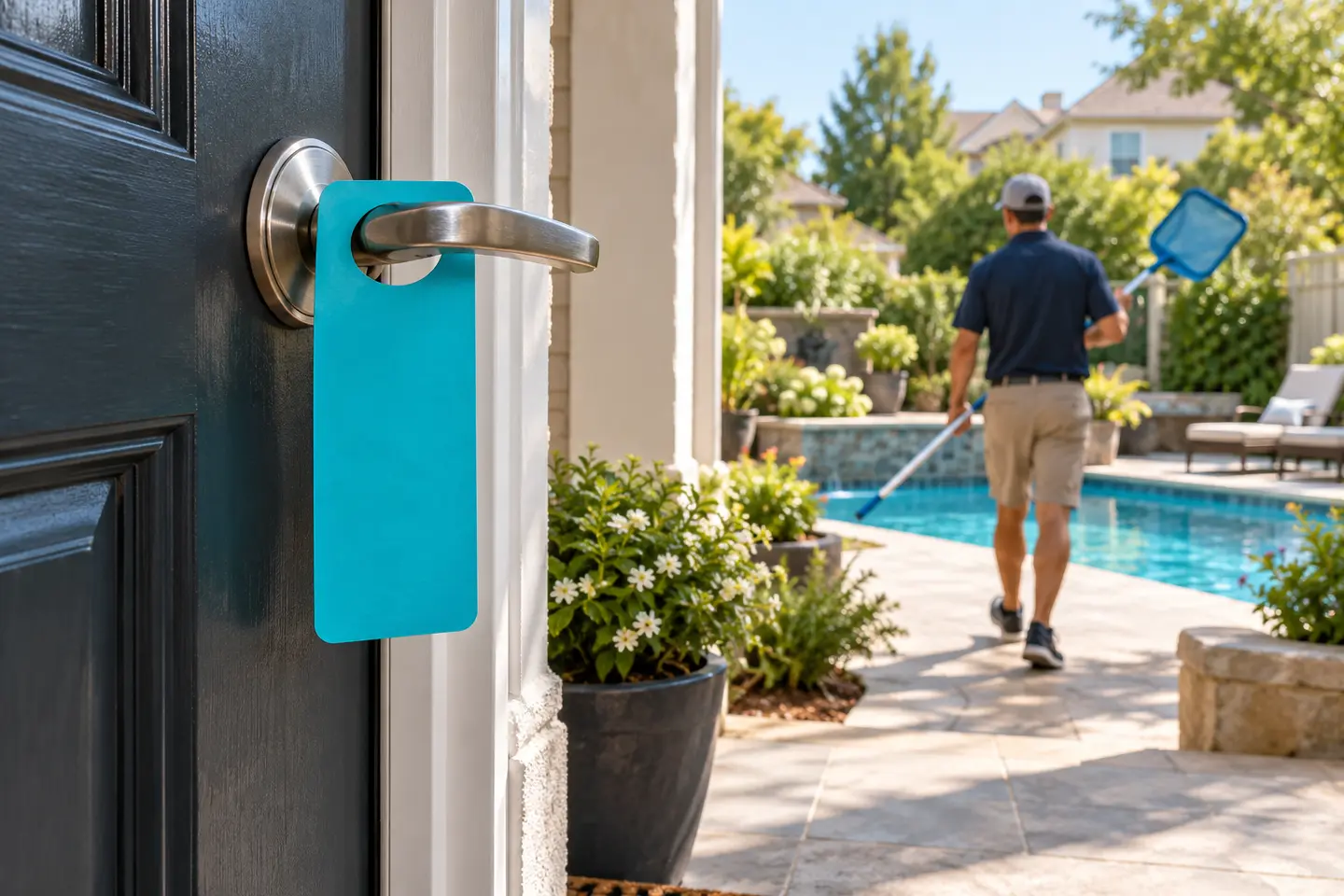
Door hangers are commonly designed as a narrow vertical piece with a die-cut opening around the handle. Ask your print provider for its current template, trim, bleed, safe area, paper options, and hole placement before finalizing a design. Common finished sizes include 3.5 × 8.5 inches and 4.25 × 11 inches, but suppliers and equipment vary.
Before ordering the full batch:
- Export a print-ready PDF using the printer’s specifications, not a low-resolution screenshot.
- Keep important text away from the trim and handle cut-out.
- Print one proof and check the small text, contrast, QR code, colors, and both sides in real light.
- Scan the QR code from the printed proof and confirm it opens the correct page on a phone.
- Use a short tracking URL or campaign parameter, for example
?utm_source=door_hanger&utm_medium=print&utm_campaign=neighborhood_a. - Order a quantity that suits the test area and your follow-up capacity. A smaller first run can reveal design and response problems before a larger spend.
The Etsy kit linked above provides editable starting designs. Replace sample text, photos, services, and contact information with assets you are allowed to use and claims your business can support.
Distribute responsibly and check local rules
Door-hanger rules can vary by city, property, and homeowners association. Before distributing, check local solicitation or handbill ordinances, posted “no soliciting” signs, gated-community rules, and any property-manager requirements. Do not enter restricted areas, disturb residents, or leave materials where they may create a safety or litter problem.
In the United States, USPS says advertising should not be put inside or attached to a mailbox; use an allowed entry door or another compliant delivery method and follow current postal guidance. See the USPS guidance on flyers and mailboxes. A paid postal option such as Every Door Direct Mail is a separate way to reach eligible routes through the mail system.
Track inquiries and booked work
Give each route test its own identifier, QR destination, or offer code. If a homeowner calls without using one, ask, “Where did you hear about us?” and record the answer. Keep the tracking question neutral; do not pressure people to say they saw the hanger.
Measure the full cost, including staff time:
Total campaign cost = printed quantity × cost per hanger + distribution hours × labor cost per hour
Then calculate:
- Cost per inquiry = total campaign cost ÷ inquiries
- Cost per booked customer = total campaign cost ÷ customers booked
- Conversion rate = customers booked ÷ inquiries
Worked example (illustrative, not a result claim)
Suppose a business prints 500 hangers at $0.20 each and spends three hours distributing them at an internal labor cost of $20 per hour:
- Printing: 500 × $0.20 = $100
- Distribution labor: 3 × $20 = $60
- Total campaign cost: $160
- If five people inquire, cost per inquiry is $32.
- If two become customers, acquisition cost is $80 per booked customer.
These numbers are examples only; use actual local printing prices, wages, responses, and booked work. Compare acquisition cost with expected gross profit over a realistic customer period, after service labor, supplies, travel, payment fees, and churn—not with sales revenue alone. A low-cost inquiry is not useful if it never becomes profitable work or cannot fit the route.
Run a four-week test before scaling
Keep the first experiment simple enough to interpret:
| Week | Action | What to record |
|---|---|---|
| 1 | Select one small route, confirm service capacity, and finalize one message. | Route ID, offer, planned quantity, route day, and print quote. |
| 2 | Print a proof, test every contact path, check local rules, then distribute the test batch. | Actual quantity, print cost, date, hours, and any delivery issues. |
| 3 | Reply to inquiries using your normal process and ask how each person found you. | Inquiry date, source, qualification, quote sent, and follow-up date. |
| 4 | Count booked jobs and calculate total cost, cost per inquiry, and cost per booked customer. | Booked work, route fit, expected margin, and a decision to stop, revise, or repeat. |
Change one major variable at a time—such as headline, offer, or route—so the next batch teaches you something. If you change the neighborhood, design, price, and response channel together, you will not know which change affected the outcome.
Turn a good route visit into a repeatable process
Marketing creates expectations; the service visit has to fulfill them. Document what a technician should prepare, what the agreed service includes, what to record, and how to close out a visit. Keep route lists and customer property details private, and only film or photograph a property with permission.
Vid2SOP can capture images from a video as an editable visual draft. You write and review each instruction before using or sharing the SOP; the current version does not transcribe speech or automatically write the procedure. See how to market a pool cleaning business, 30 pool service social media ideas, and the pool service pricing guide for related planning.
Frequently asked questions
How many pool service door hangers should I print?
Start with a quantity you can distribute and measure in one clearly defined area. Check the print proof and route capacity first. Increase the next batch only after you understand the actual cost, response, and booking quality.
Should the hanger offer a discount?
Not necessarily. You can ask a homeowner to request a quote or check route availability. If you do offer a discount, state the full terms and confirm it still leaves enough margin to do the work properly.
Is a QR code enough?
No. Some people prefer to call, and some phones or printed codes fail. Include a readable phone number or short URL as an alternative and test the QR code from a printed proof.
How can I connect hangers with online marketing?
Use a route-specific landing page or tracking parameters, then compare those visits with calls and bookings. A hanger can reinforce your website and local profile, but it should not replace accurate service details, real customer reviews, or timely follow-up.
Put your process into practice
Turn a well-run route into a repeatable team process: capture the visual steps, write and review each instruction, then share the SOP with your crew. Use the campaign tracker to record route, cost, inquiries, and booked jobs before you print again.
Create your SOP