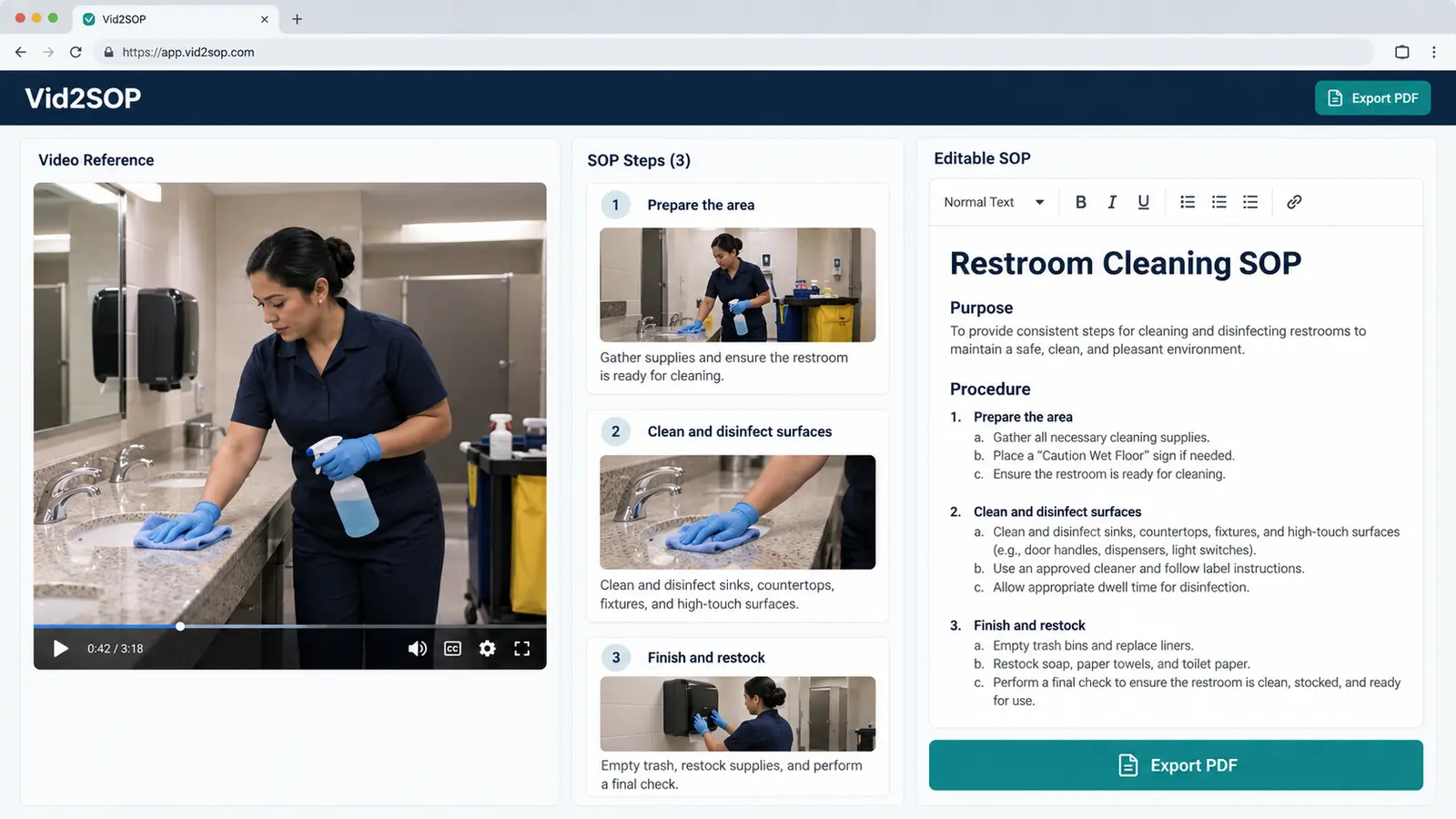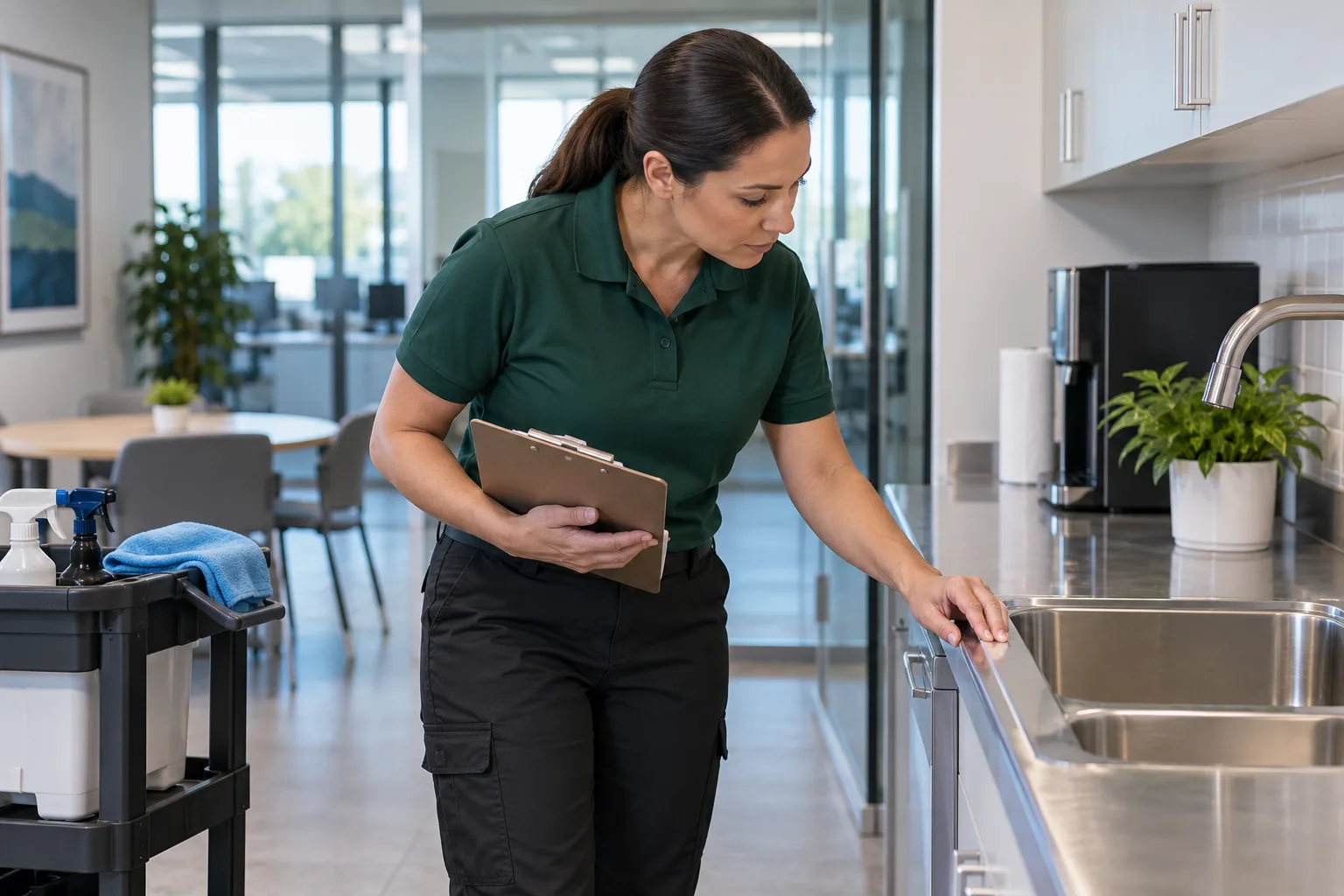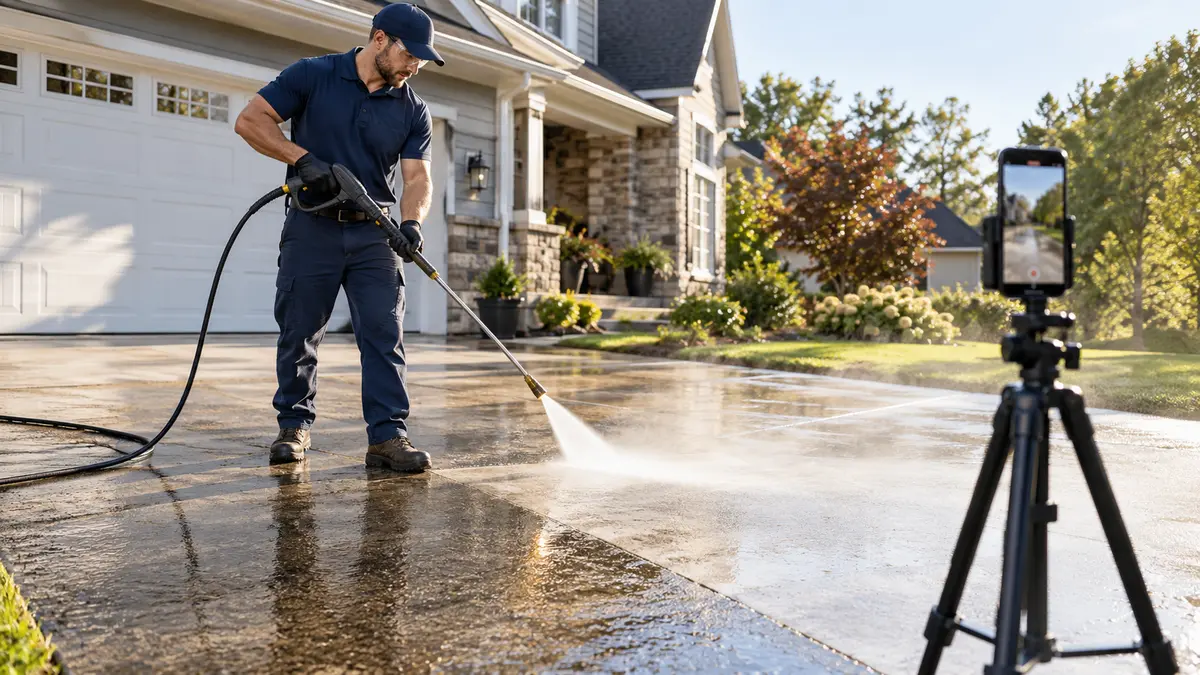
The video you record on a driveway job can do two jobs.
Posted online, it shows local customers exactly what your business can do. Kept in full, it shows your next new hire exactly how your team does the work. Most pressure washing companies only use it for the first.
This guide gives you 30 social media post ideas, each with a caption you can adapt, plus five short video formats, a practical hashtag approach, a monthly posting plan, and a simple way to turn the same job footage into a written procedure for your crew.
Use the ideas on Facebook, Instagram, TikTok, YouTube Shorts, or your Google Business Profile—wherever local property owners look for service providers.
Want editable designs to put these ideas into practice? Our Pressure Washing Canva Marketing Kit on Etsy includes 100 social post templates and 100 captions you can customize for your business.
Why social media works for pressure washing
Pressure washing is one of the most visual services a local business can sell. A dark driveway, a green patio, or a weathered fence becomes proof of your work the moment it is clean.
Before requesting a quote, customers want to see:
- the surfaces you clean and the results you get;
- whether you work carefully around their property;
- whether other people in their area trust you; and
- how to contact you.
Your goal is not likes from around the world. It is to help property owners in your service area recognize a problem, trust your work, and ask for a quote.
Build your content around five pillars
Instead of inventing every post from scratch, rotate through five categories:
- Results: before-and-after proof.
- Education: surfaces, stains, maintenance, and methods.
- Trust: your team, your process, and genuine reviews.
- Local and seasonal: your neighborhoods, weather, and property types.
- Lead generation: clear invitations to request a quote.
Promotional posts work best when the other four pillars have already done the convincing.
Before using the captions below, replace everything in [brackets] and only describe what actually happened on the job. A confident caption is useful; an inaccurate one costs trust.
30 pressure washing social media post ideas
Results posts
1. Driveway transformation
Show the same section of driveway before and after, from the same angle.
Caption: “Same driveway. Same angle. One visit. This one in [City] had years of tire marks and dark buildup. Want to see what yours could look like? Send us a photo for an estimate.”
2. Patio restoration
Photograph the patio before, then the cleaned result in similar light.
Caption: “This patio was too green to enjoy. Now it’s ready for evenings outside again. Swipe to see the before. Patio in [Neighborhood]? Message us for a quote.”
3. Fence cleaning result
Use a close-up that shows the color difference clearly.
Caption: “The original color was there the whole time—just hidden under years of weather and grime. Fence cleaning in [City].”
4. The half-clean line
Clean one strip of a walkway first and photograph the contrast before finishing.
Caption: “We cleaned one strip first so you can see the difference. Then we finished the rest. Which side looks like your walkway?”
5. Commercial entrance
Show a storefront, office entrance, or walkway at a local business.
Caption: “Customers judge a business before they walk through the door. We [scheduled this clean around opening hours] for [Business type] in [City].”
6. Multi-surface project
Feature a job with two or more surfaces.
Caption: “Driveway, patio, and front steps. One visit, three surfaces, each cleaned with the method that suits it.”
Education posts
7. Pressure washing vs. soft washing
Explain that the right method depends on the surface, its condition, and the type of buildup.
Caption: “More pressure isn’t always better. Concrete can handle a different approach from siding, roofs, or painted wood. We choose the method for the surface, not the other way around.”
8. Why driveways turn dark
Explain how traffic, oil drips, moisture, shade, and organic growth build up over time.
Caption: “Why does a driveway go from gray to almost black? Tire traffic, oil drips, moisture, and shade all add up. The good news: much of it can be cleaned.”
9. How often to clean
Avoid a universal timetable. Explain the factors that change it.
Caption: “How often should you clean your driveway? There’s no single answer. Shady, damp areas grow algae faster than sunny ones. Ask us and we’ll tell you what makes sense for your property.”
10. Three signs a walkway needs attention
Caption: “3 signs your walkway needs cleaning: it looks darker in patches, it gets slippery after rain, and the joints have turned green. Spotted one? Send us a photo.”
11. How to prepare for an appointment
Caption: “Booked a clean? Here’s how to get ready: move cars and patio furniture, bring in fragile décor, unlock the gate, and close nearby windows. We handle the rest.”
12. Why the site walk-around matters
Explain what you look for before starting: delicate areas, drainage, existing damage, and access.
Caption: “Before we start, we walk the property. We check for loose paving, delicate plants, drainage, and existing damage. A few minutes that help protect your home.”
13. Common DIY mistakes
Caption: “Renting a pressure washer this weekend? Avoid these 3 mistakes: holding the nozzle too close, using too much pressure on wood, and forgetting where the runoff goes.”
14. Why green growth keeps coming back
Caption: “Green coming back on the same side of the house every year? Shade, moisture, and poor airflow keep that area damp. Cleaning removes it, and trimming nearby plants may help slow its return.”
Trust posts
15. Meet the owner or team
Caption: “Hi, I’m [Name], owner of [Business]. We’ve been cleaning driveways and patios across [Service Area] since [Year]. I started this business because [one honest sentence].”
16. Behind-the-scenes setup
Show hose management, plant protection, and work-area preparation.
Caption: “What happens before the first spray: hoses laid safely, plants protected, gates secured. The setup takes time, and it’s why the job goes smoothly.”
17. Daily equipment check
Caption: “Every workday starts with the same check: hoses, fittings, nozzles, and the machine. We don’t skip it.”
18. Genuine customer review
Turn a real review into a simple graphic and pair it with a photo of that project. Never invent testimonials or change the meaning of a customer’s words.
Caption: “‘[Short quote from the customer’s actual review].’ Thank you, [First name]! Here’s the patio we cleaned for you.”
19. Answer one real customer question
Pick a question you hear often, such as “Do I need to be home?” or “Can every surface be pressure washed?”
Caption: “‘Do I need to be home?’ We get this one a lot. [Your actual answer and policy]. We’ll confirm everything when you book.”
20. Team training moment
Show a new team member learning your process from an experienced one.
Caption: “New team member, same standard. Everyone on our crew learns our process step by step before working on a customer’s property.”
This is also the perfect moment to record the full demonstration. See Record once, use twice below.
21. Final quality check
Show a team member inspecting edges, corners, and drains before leaving.
Caption: “The job isn’t done when the machine turns off. We check edges and corners, rinse away debris, and make sure the area is safe before we leave.”
Local and seasonal posts
22. Neighborhood project
Name the area, never the customer’s exact address.
Caption: “Another driveway finished in [Neighborhood] this week. We’re back in the area on [Day]. Message us if you’d like a quote.”
23. Seasonal exterior checklist
Caption: “[Season] checklist for your home’s exterior: driveway, patio, walkways, fence, front steps. Which one needs attention first?”
24. After-rain reminder
Caption: “After a rainy week, dark patches and green spots show up more. Take a look at your shady corners this weekend.”
25. Getting ready for guests
Caption: “Hosting this [season]? The patio is the first thing guests see when they step outside. Book ahead of your event date.”
26. Tip for property managers
Caption: “Property managers: schedule exterior cleaning before inspections and move-ins, not after complaints. A clean entrance sets the tone for the whole building.”
Lead-generation posts
27. This week’s availability
Only share real availability. Never invent scarcity.
Caption: “We have [number] openings next week in [Service Area]. Send a photo of your driveway, patio, or fence and we’ll reply with an estimate.”
28. What to send for a fast quote
Caption: “Want a fast, accurate quote? Send us your area, the approximate size, 2 or 3 photos, and any access notes. We’ll get back to you within [time frame].”
29. Service-area graphic
Caption: “Where we work: [City 1], [City 2], [City 3], and nearby. Not sure if you’re covered? Ask us.”
30. Problem to solution
Caption: “Front walkway looking tired and dark? That’s often surface buildup, not permanent damage. Send us a photo and we’ll tell you honestly what a clean can do.”
Five short video formats that work for pressure washing
Satisfying cleaning clips are strong content for Reels, TikTok, and Shorts. Rotate these five formats:
- The reveal: one slow pass across a dark surface, showing the clean line appear.
- Half and half: a split-screen or a single frame with one side cleaned and one side untouched.
- The timelapse: the full job compressed into 15 to 30 seconds.
- Point of view: footage from a securely mounted camera showing what the operator sees.
- Before-after transition: the same angle, switching from before to after on a beat or a swipe.
Tips for better clips:
- Film vertically (9:16) for Reels, TikTok, and Shorts.
- Show the contrast in the first two seconds.
- Add on-screen text with the surface and area, for example “Driveway, [City].”
- Keep house numbers, license plates, and faces out of frame unless you have permission.
- Never hold a phone while operating equipment. Use a stable mount or ask a teammate to film.
Record once, use twice: turn job videos into team SOPs
The clip that gets views online shows how your team does the job. The full recording can teach the next person you hire.
Most companies cut 20 seconds for social media and discard the rest. Instead:
- Record the whole process on a well-run job: setup, site walk-around, surface assessment, method, final check, and cleanup. Narrate the key steps as you go.
- Cut short clips from that footage for your social media posts.
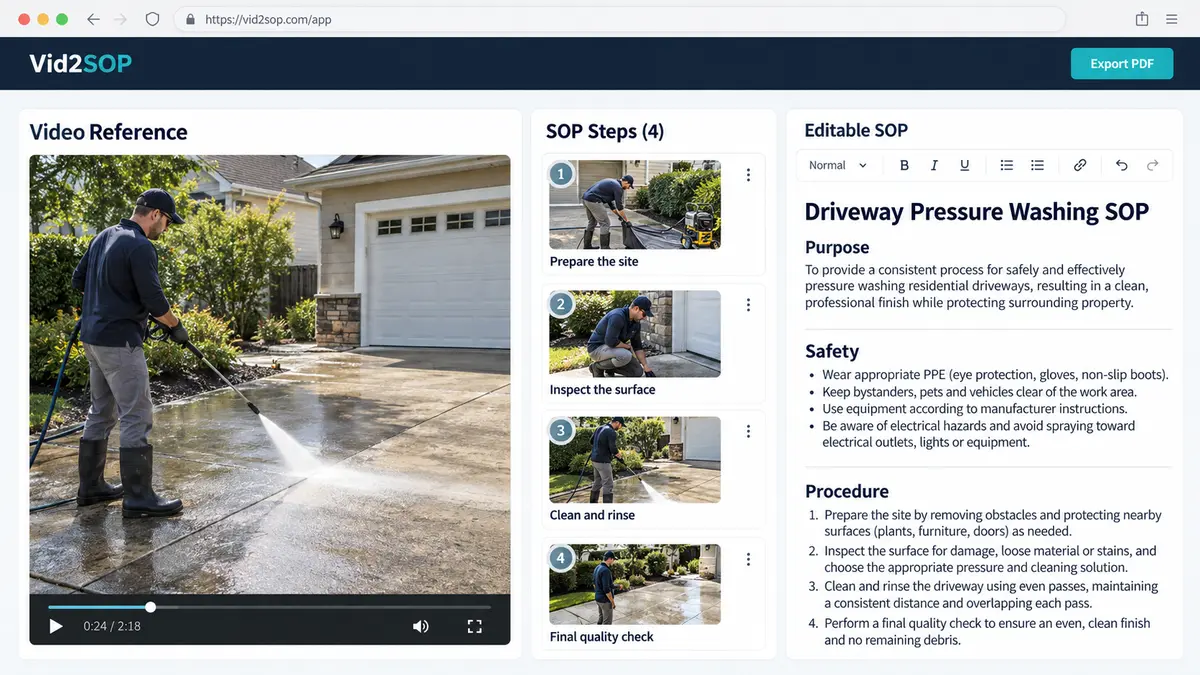
- Upload the full recording to Vid2SOP. It turns the video into an editable SOP draft with visual steps.
- Review and complete the draft. Add your company rules, including the surfaces that need a gentler method, equipment checks, and how to protect plants and drains.
- Share the approved SOP with your crew and use it when training new team members.
A supervisor should always check the draft for accuracy before it is used, and an SOP does not replace hands-on training. It gives your team a consistent reference, so the quality customers see in your posts is the quality they get on every job.
Turn your next job video into an SOP with Vid2SOP →
How to write stronger captions
A good caption does not need to be long. Use this four-part formula:
- Hook: name the visible problem or the result.
- Context: say what the customer is looking at.
- Trust detail: mention the inspection, the method, or the final check.
- Call to action: tell the customer exactly what to do next.
Example:
A clean driveway changes how the whole house looks from the street.
This one had years of dirt and dark buildup. We walked the site first, used a method suited to the concrete, and did a final check before we left.
In [Service Area]? Send us a photo of your driveway for an estimate.
Hashtags: keep them local and relevant
Treat hashtags as labels, not as a substitute for a useful caption. Use a short, relevant mix and adjust it for the platform:
- Local: #[City]PressureWashing, #[City]HomeImprovement, #[Neighborhood]
- Service: #PressureWashing, #SoftWashing, #DrivewayCleaning, #PatioCleaning
- Format: #BeforeAndAfter, #Satisfying, #CleaningVideo
Test a small set, keep the tags closely related to the post, and compare the results in your platform analytics. Clear location words in the caption and profile are more useful than a long block of generic tags when the objective is to reach local customers.
Turn the ideas into a monthly plan
You do not need to post every day. Three useful posts per week is a practical starting point for a small team.
| Week | Post 1 | Post 2 | Post 3 |
|---|---|---|---|
| Week 1 | Before and after | Education tip | Quote call to action |
| Week 2 | Behind the scenes | Customer review | Neighborhood project |
| Week 3 | Short video: reveal or timelapse | Team or process post | Before and after |
| Week 4 | Customer question | Seasonal checklist | Real availability post |
That is 12 posts a month, balanced across proof, education, trust, and promotion. Next month, repeat the structure with new jobs, questions, and surfaces.
Photograph every job with future content in mind
Use the same routine on every suitable job:
- Take a wide before photo.
- Take a close-up of the main problem.
- Record the process on video—vertical clips for social media and a complete recording for your SOP library.
- Take the after photo from the original angle.
- Capture one detail shot of the finished surface.
- Get the customer’s permission before publishing anything that could identify their property.
Name your files consistently so you can find them later:
date-location-surface-beforedate-location-surface-afterdate-location-surface-process
What every post design should include
Keep designs simple:
- a short headline;
- one strong project image;
- your business name or logo;
- the correct service area; and
- one clear call to action.
Avoid paragraphs of text, several phone numbers, or multiple offers in one design. The image attracts attention; the caption explains.
Use a ready-made social media kit
Creating every design and caption separately can turn a simple posting plan into hours of work.
Some owners search for pressure wash posts, cleaning marketing resources, Instagram templates, a contractor template, a local business kit, or a complete marketing bundle. Although the wording differs, the objective is the same: help a service business publish consistent, professional content without designing every post from scratch.
The Pressure Washing Canva Templates and Social Media Kit on Etsy includes 100 social media post templates, 100 ready-to-use captions, and additional editable marketing assets created for pressure washing and power washing businesses.
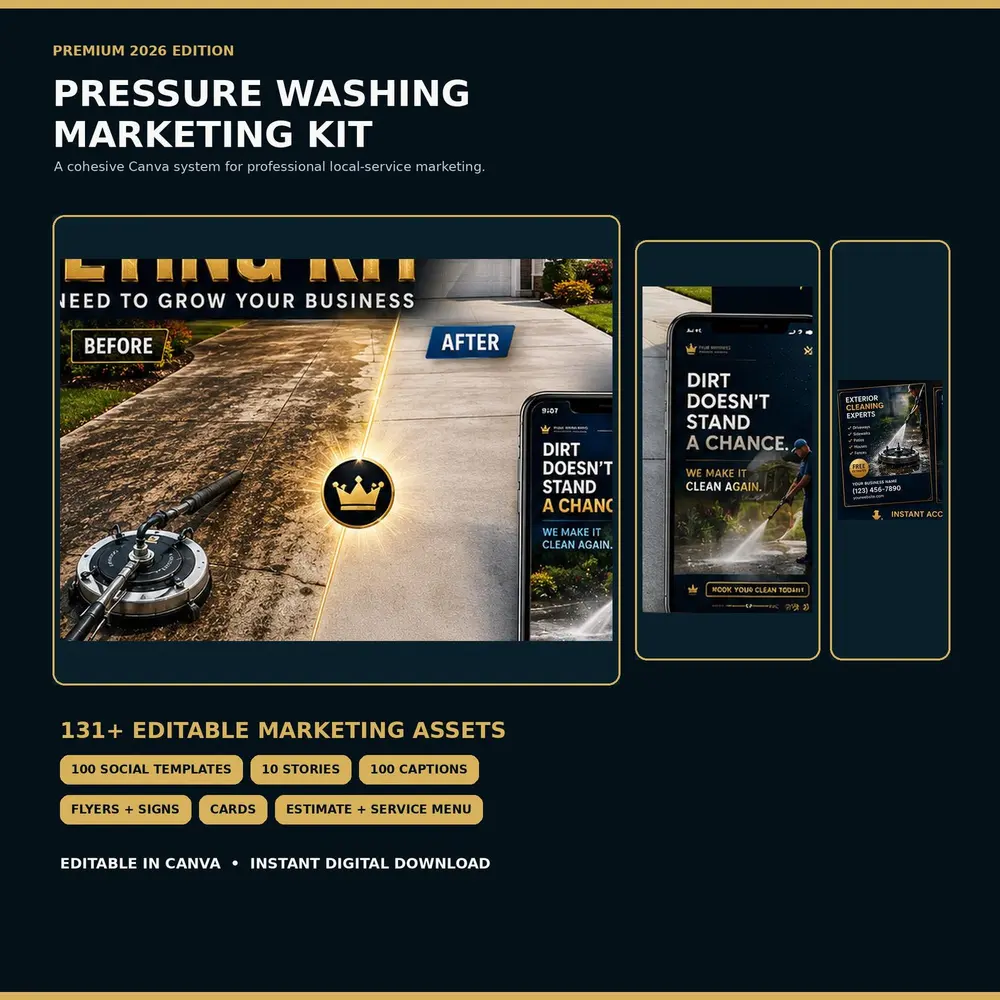
Customize every design with your own photographs, logo, services, contact information, offers, and service area before publishing.
Disclosure: This guide includes a link to a digital product from Local Growth Studio on Etsy.
Frequently asked questions
What should a pressure washing business post on social media?
Use a balanced mix of before-and-after results, short cleaning videos, educational tips, behind-the-scenes content, genuine reviews, local projects, answers to customer questions, and clear invitations to request a quote.
How often should a pressure washing company post?
Consistency matters more than volume. Three useful posts per week is a practical starting point for many small local businesses, but the right schedule is one your team can maintain without lowering quality.
Are videos better than photos for pressure washing?
Both can work. Short videos demonstrate motion and contrast, while before-and-after photos are quick to produce and easy to reuse across several platforms. Use both and compare actual inquiries, not only views.
What hashtags should a pressure washing business use?
Start with a short mix of local, service, and content-format tags. Keep them relevant to the exact post and use platform analytics to test what contributes to discovery. Avoid copying an oversized generic list onto every post.
Is power washing content different from pressure washing content?
Customers often use the two terms interchangeably. Describe the method you actually use rather than choosing a term only because it gets more searches.
Can I reuse the same post?
Reuse the idea, not the exact post. Change the photo, hook, project details, or customer problem. A repeatable format is useful; duplicate content is less useful to your audience.
Do before-and-after posts need customer permission?
Get permission whenever the content could identify the customer or their property. Remove house numbers, license plates, faces, and other private details that are not needed.
Can social media videos be used to train my team?
Yes. Keep the full recording of a well-run job. With Vid2SOP, you can turn it into an editable, step-by-step SOP draft, review it, and use it as a training reference alongside hands-on practice.
Start with your next job
Every completed job can produce several posts and a training resource. On your next job, take the photos, record the full process, cut a short clip for social media, and turn the complete video into a procedure your whole crew can follow.
See how Vid2SOP turns job videos into SOPs →
Editorial note
This article provides general marketing and operational information. Verify customer permissions, platform rules, advertising requirements, image rights, and service claims before publishing content.
Put your process into practice
Record a well-run job once, turn the full video into an editable SOP, and reuse the best moments in your marketing.
Create your SOP