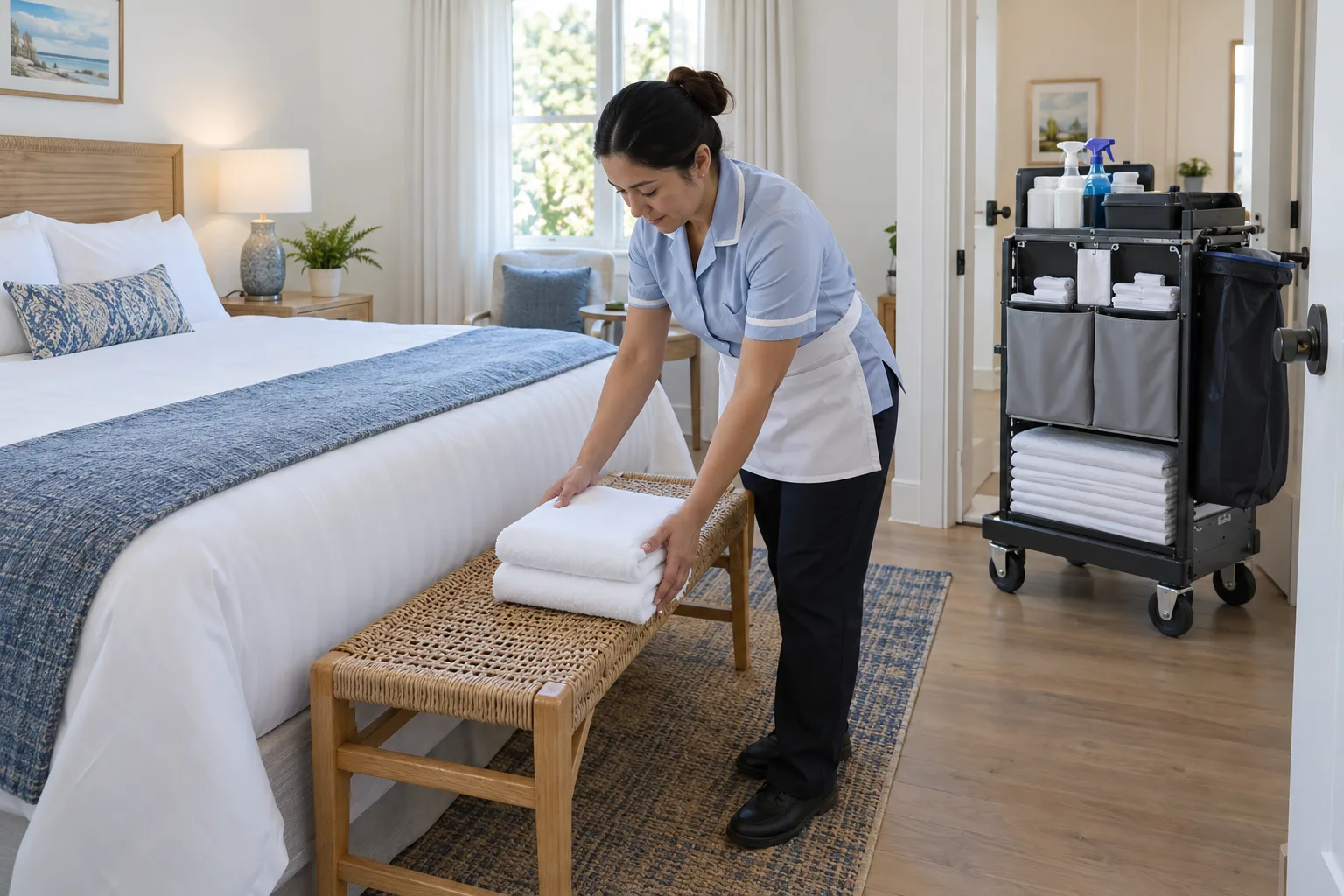
A cleaning inspection checklist records whether completed work meets the agreed standard. It is different from a cleaner's task list: "floor mopped" records an activity, while "accessible floor edges are free of visible debris and the handover route is safe" describes an acceptance check.
Use this guide for ordinary cleaning-service quality reviews, not laboratory testing, infection-control certification, or regulated facility audits. A visual inspection cannot establish microbial safety. The scoring model below is an example management tool, not an industry certification or mandatory threshold.
Get the working version: Open the printable inspection scorecard or download the editable CSV. Use your browser's print menu to save a PDF. No email is required.
Agree on the standard before scoring the job
The reviewer should inspect the same scope the team was asked to deliver. A new expectation introduced after the visit creates a dispute rather than useful quality data. Start from the service agreement and the current cleaning procedure.
For each line, identify a location and observable criterion. "Restroom acceptable" is too broad. "Mirror has no visible streaks under normal room lighting" is a check a cleaner and reviewer can interpret similarly. Separate cleaning issues from maintenance defects such as cracked tiles, worn finishes, or a leaking fixture.
If the task needs a method rather than a result description, link it to a cleaning SOP. The inspection sheet should not become a second, contradictory procedure.
Use statuses that do not hide unfinished work
| Status | Meaning | Follow-up |
|---|---|---|
| Pass | The inspected criterion meets the agreed standard | Record reviewer and time |
| Rework | An applicable check does not meet the standard | Assign correction and recheck |
| Blocked | Access or another condition prevents a valid check or completion | Record reason and decision owner |
| N/A | The item does not apply to the agreed scope | Record why it is excluded |
| Not inspected | No valid review has been performed yet | Keep review open |
Do not use N/A for work that was forgotten. Do not convert a blocked task into a pass because the cleaner cannot resolve it. These distinctions keep the score from rewarding incomplete records.
Inspect the job by zone
Choose checks that represent the service and its recurring failure points. Review high-priority exceptions on every applicable visit. If you sample other tasks, state which areas were sampled; do not present a sample as a complete property inspection.
| Zone | Example acceptance check | What to record if it fails |
|---|---|---|
| Entrance | Agreed waste removed and access clear | Location and remaining obstruction |
| Floors | Accessible edges free of loose debris | Room, edge, and corrective task |
| Desks or furniture | Approved surfaces visibly clean; belongings undisturbed | Surface and observed issue |
| Glass and mirrors | No visible marks under normal lighting | Panel or mirror identifier |
| Restrooms | Agreed fixtures visibly clean and contracted supplies present | Fixture, supply count, or exception |
| Breakroom | Included counters, sink, and appliance exteriors checked | Specific residue or missed area |
| Closeout | Equipment removed and agreed access/security steps confirmed | Unfinished handover action |
Use the office cleaning checklist for recurring office tasks. For rooms with linens and readiness decisions, use the housekeeping checklist as the task record behind this review.
Calculate a transparent score
For a simple equal-weight example, give each applicable check one point for pass and zero for any other status. Exclude genuine N/A items from the denominator. Keep blocked and not-inspected items in the denominator so unfinished reviews do not improve the score.
Score = passed applicable checks / total applicable checks x 100.
Suppose a sheet has 12 checks. Two are genuinely N/A, leaving 10 applicable checks. Eight pass, one needs rework, and one is blocked. The score is 8 / 10 x 100 = 80%, and the review is incomplete because of the blocked item. The score is a progress indicator, not permission to release the job.
If there are no applicable checks, report "no applicable checks" rather than 0% or 100%. If you introduce weights later, document them before the inspection and apply them consistently. Do not change the denominator after a disappointing result.
Keep critical failures outside the average
A site can have a high score and still be unready. Define critical checks before work begins, according to the property and service agreement. Examples may include an unresolved access/security issue, an unsafe handover route, or a missing contracted item required before occupancy.
For the example template, the decision rule is deliberately conservative: any failed, blocked, or uninspected critical check keeps release pending. A supervisor must also resolve other exceptions according to the agreed acceptance policy. The template does not set a universal pass percentage.
Do not mark every cosmetic defect critical. Separate issues that prevent handover from ordinary corrections, and keep an explanation for each critical designation. This helps the team prioritize without treating a missed fingerprint like an immediate safety problem.
Write rework notes someone can act on
An actionable note contains the exact place, observation, required correction, owner, and recheck. Avoid judgments about effort or attitude in the inspection record.
Weak note: "Bad cleaning in kitchen."
Useful note: "Breakroom, cabinet beside sink: visible crumbs remain at front edge. Assigned cleaner to remove using the approved method. Supervisor to recheck before closeout."
The reviewer should record the initial result and the recheck rather than overwrite the original failure. This preserves the difference between first-pass quality and final accepted work. For internal analysis, repeated corrections may reveal a missing instruction, equipment issue, access problem, or training need.
Use photos as supporting evidence, not the whole inspection
Take photos only when permitted, necessary, and consistent with the client's rules. Capture the specific issue and enough surrounding context to identify the location. Avoid personal documents, faces, access codes, and unrelated possessions. Do not use AI-generated images as proof of work.
When documenting a correction, keep the same viewpoint where practical and label the original and recheck clearly. Do not edit an evidence photo in a way that conceals the condition. Keep records according to the agreed retention policy.
A photo can show visible debris or a missing item. It cannot prove that an appropriate product was used, a contact time was met, or every room was inspected. Where process records matter, check the actual procedure and completion record in addition to the photograph.
Run a five-stage review
- Prepare: open the correct property, date, scope, and checklist version.
- Inspect: record each reviewed criterion and identify any sampling limits.
- Assign: give every failure or blocker an owner and next action.
- Recheck: record corrections separately, including reviewer and time.
- Close: document the release decision and any explicitly accepted exceptions.
On small solo jobs, the cleaner may perform a second-pass self-check. Label it as self-review rather than independent quality assurance. On larger jobs, a separate reviewer can provide a fresh assessment where staffing allows.
Frequently asked questions
What should a cleaning inspection checklist include?
Property, date, scope, reviewer, location-specific criteria, status, critical flag where justified, exceptions, correction owner, and recheck. Include a final release decision outside the numerical score.
What is a good inspection pass rate?
There is no universal rate for this template. Agree on acceptance rules for the service and never use an average to override an unresolved critical item. Track your own first-pass and final results separately.
How often should a supervisor inspect?
Set the review frequency according to the contract, task risk, staff experience, and past issues. A new process or recurring complaint may justify closer review. Document any sampling plan and its limits.
Can this prove that a room is disinfected?
No. It is a visual and operational quality record. It does not measure pathogens or certify disinfection. Specialized settings require their own procedures and verification methods.
Editorial scope and source note
The status model, score, and examples are original Vid2SOP operational templates, not an accredited audit scheme. For the distinction between cleaning and disinfecting, see CDC cleaning guidance. Have a competent supervisor adapt the criteria and approve the release policy before use.
Put your process into practice
Document the cleaning method and acceptance checks in one reviewed visual SOP.
Use the checklist to identify instructions that need clarification. Update the demonstration and review the resulting SOP before sharing the revised method with your team.
Create your SOP