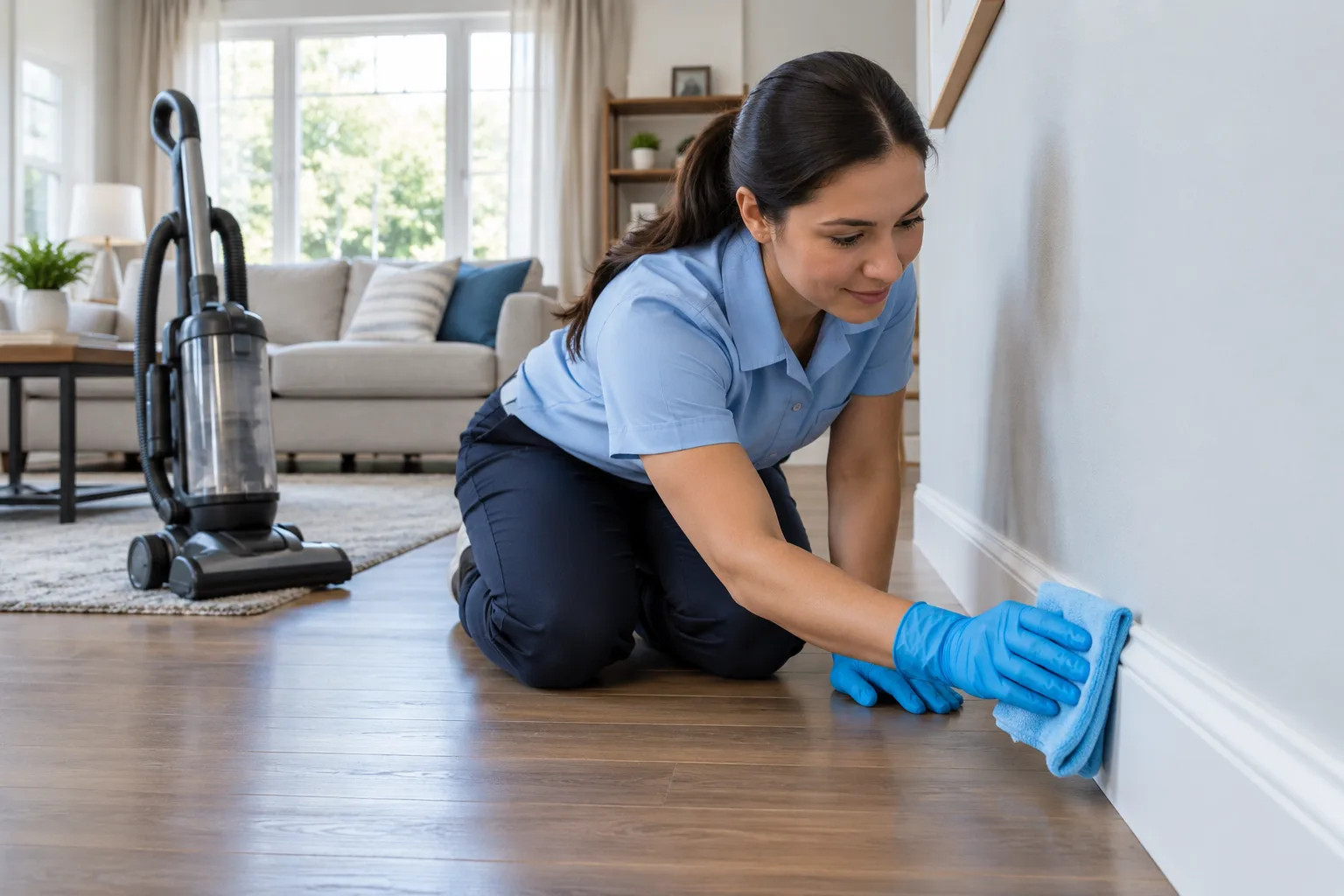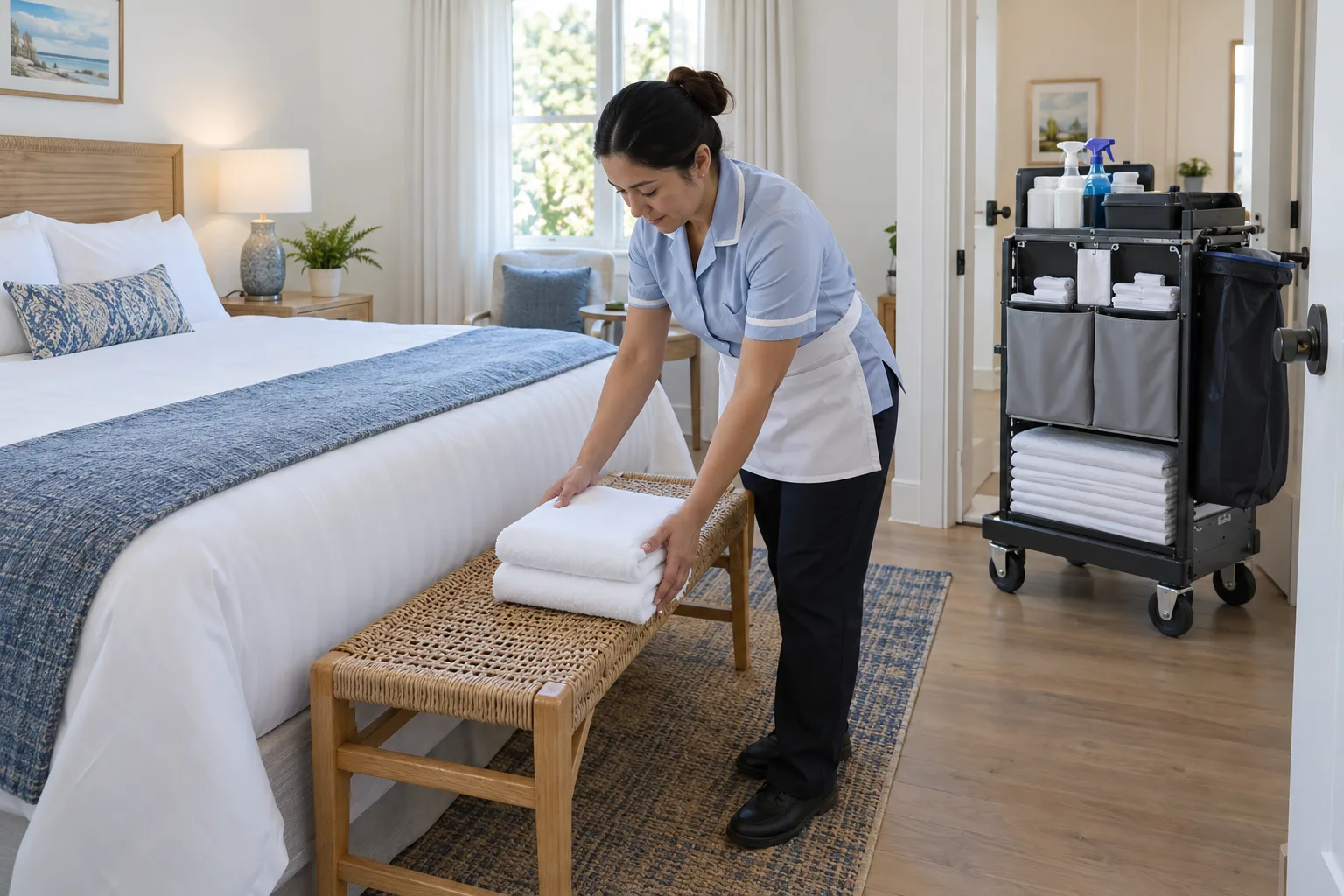
A useful housekeeping checklist records the room, required task, assigned cleaner, completion status, exceptions, and reviewer decision. It should show whether a room is ready to release, not simply whether someone ticked every box. A blocked room must remain visibly blocked until the responsible person resolves the issue.
This guide focuses on ordinary residential and guest-room housekeeping. It is an editable operational starting point, not a hotel accreditation standard, healthcare protocol, or guarantee of hygienic conditions.
Use the template: Open the printable housekeeping checklist or download the editable CSV. Print it or save it as a PDF from your browser. No email is required.
Define the room type and service first
A guest departure clean, an occupied-room refresh, and an occasional detail clean should not use an identical task list. Create a shared core, then add only the tasks belonging to that service. Otherwise, staff may open belongings they should leave untouched or spend time on work that was never booked.
| Service | Core focus | Confirm separately |
|---|---|---|
| Occupied-room refresh | Agreed surfaces, waste, supplies, and room reset | Permission to enter and treatment of personal items |
| Departure or turnover | Full agreed room reset for the next occupant | Linen replacement, inventory, access, and readiness deadline |
| Periodic detail clean | Accessible edges and tasks outside routine coverage | Extra time, furniture access, and specialty surfaces |
For a short-term rental, the Airbnb turnover checklist covers guest-readiness checks alongside cleaning. For an office contract, use the separate office cleaning checklist rather than importing linen and room-release tasks.
Record six things on every checklist
- Location: property and room identifier, with enough detail to avoid confusion between similar rooms.
- Service: date, visit type, included tasks, and any client-specific restrictions.
- Owner: the person responsible for each zone, plus the reviewer where one is assigned.
- Status: done, rework, blocked, or not applicable. A blank status means unrecorded, not complete.
- Exception: the exact issue, next action, owner, and expected follow-up.
- Release decision: who checked the room, when, and whether outstanding issues prevent handover.
Keep access codes and unnecessary personal information off general paper checklists. Store any operational access information in the approved secure system instead. Photos should focus on the work and avoid documents, guests, personal belongings, and other identifying details whenever possible.
Before-entry and setup checklist
Confirm authorization to enter and check occupancy or access restrictions. Review the latest notes rather than assuming the room is identical to the previous visit. If access is denied, mark the task blocked and contact the assigned coordinator.
Check that supplies, replacement linen, waste bags, and appropriate tools are available. Separate clean and used materials. Do not substitute an unfamiliar cleaning product because a preferred bottle is empty; follow the approved product and surface instructions.
Look for damage or unusual conditions before working. Record existing damage with permission and report hazards through the site's process. If the room cannot be serviced safely, stop that part of the work and escalate it. A checkbox is never an instruction to take a risk.
Room-by-room housekeeping tasks
The following table is a task framework. Replace general descriptions with the exact service standard agreed for the property, including what to leave untouched.
| Zone | Cleaner task | Reviewer checks |
|---|---|---|
| Entry | Remove agreed waste and clean accessible touchpoints | Clear access, no supplies left at the doorway |
| Sleeping area | Service the bed and approved furnishings | Correct linen set and agreed room arrangement |
| Bathroom | Complete the approved fixture and surface routine | No visible residue; contracted supplies present |
| Kitchenette | Clean included counters, sink, and appliance exteriors | Visible debris removed; contents handled as instructed |
| Living area | Clean accessible surfaces and reset approved items | Belongings respected; furniture in agreed positions |
| Floors | Vacuum or clean using the appropriate method | Edges checked and handover route safe |
Avoid vague instructions such as "make the room perfect." A standard should be observable: the agreed towel count is present, the waste container is empty, the mirror has no visible marks, or the room is arranged according to an approved reference. Keep the reference current and available to the person doing the work.
Separate recurring work from periodic detail tasks
Put every-visit tasks in the core checklist. Put lower-frequency tasks in a schedule with a due date and owner, rather than printing them on every visit and hoping someone remembers when they were last completed.
For example, routine service may include accessible furniture surfaces and floors. A separately scheduled detail visit may add reachable baseboards, cabinet edges, or interior glass. The frequency is a contract and condition decision, not a universal daily or weekly rule.
Use the deep cleaning checklist to define those detail tasks. When a periodic task is due, bring it into that visit's work order with enough time and the right equipment. Record its completion date so the next team does not repeat it unnecessarily.
Assign work so ownership stays clear
On a two-person job, avoid giving both cleaners a copy that says "bathroom: team." Assign a named owner to the bathroom and a named owner to the bedroom and living zone. Agree who completes floors after both areas are ready.
An illustrative handover might read: "Room 204, bathroom assigned to A; sleeping area assigned to B; final review assigned to supervisor C." The task owner records completion; the supervisor records acceptance. On a solo job, the same person can perform a deliberate second-pass review, but the record should not imply an independent inspection occurred.
This simple distinction also makes training more useful. If an issue keeps returning in one task, review that task's instructions and conditions before blaming the whole team. Missing supplies, unclear scope, and insufficient access can look like performance failures when they are actually planning problems.
Handle exceptions before releasing the room
Use specific, neutral notes. "Missing towel" needs a count and action: "One of the two agreed bath towels is missing; laundry coordinator to supply before release." "Maintenance issue" needs a location: "Bathroom sink tap continues dripping; reported to property contact; cleaning complete, release decision pending."
Do not check "done" for a task that could not be completed. Use "not applicable" only when the task genuinely does not belong to the visit, and give a reason where that may be unclear. Record client-approved exclusions separately from unresolved failures.
At handover, the reviewer chooses ready, not ready, or pending an explicit client decision. A high completion percentage should never hide a single unresolved issue that prevents the agreed service from being delivered. Use the cleaning inspection scorecard for a more structured review.
Example: a room is clean but not ready
Imagine a guest room where every cleaning task is finished, but a replacement linen set has not arrived. The cleaner records the completed tasks and flags linen as blocked. The reviewer does not describe the room as ready merely because its surfaces look good.
The coordinator supplies the missing linen, the assigned person completes the bed, and the reviewer records a new check time. This example shows why the release decision must sit outside the task checklist: cleaning completion and operational readiness are connected, but they are not identical.
Frequently asked questions
How do I make a housekeeping checklist?
Start with the service agreement, list included zones, assign a clear task and acceptance check to each zone, and add owners, statuses, exceptions, and release approval. Test it on an actual visit and remove ambiguous wording.
Is there a standard daily six-task checklist?
Numbered cleaning routines can be convenient reminders, but six tasks are not a universal professional standard. A team's checklist should match the property and service. Do not remove a necessary task just to fit a memorable number.
Is a checklist the same as an SOP?
No. A checklist records required work and completion. An SOP explains how to do the work, including precautions and acceptance criteria. Use the cleaning SOP template to document methods behind repeatable tasks.
Should every task need a photograph?
Not necessarily. Take relevant photos when authorized and useful for an exception, reference, or agreed proof requirement. Avoid collecting unnecessary personal information. A photo does not establish that every step of a process happened.
Editorial scope
These checklists and examples are original Vid2SOP workflow templates. They do not replace site rules, product labels, employer training, or specialized guidance. Chemical-safety considerations are outlined in OSHA/NIOSH: Protecting Workers Who Use Cleaning Chemicals. Have the responsible supervisor approve the final site-specific version before use.
Put your process into practice
Turn your approved housekeeping routine into a visual SOP your team can review.
Record an authorized demonstration of the actual room routine. Check the generated steps against your service agreement before using the SOP for training.
Create your SOP